By AZE.US Editorial Team
TikTok in Azerbaijan stopped being a harmless app for dance clips, recipes and short comedy videos a long time ago.
It has become a parallel economy built on opaque financial flows, a marketplace for public humiliation and sexualized attention, and an environment where children learn how to conceal their age before they understand the consequences of doing so.
A TikTok representative recently said the platform has about 7 million users in Azerbaijan. Even if that figure includes multiple accounts rather than unique active users, the scale is enormous. TikTok is no longer merely a social network. It is one of the country’s largest media markets, yet it provides no complete public accounting of its local revenue, gift economy, taxes, audience ages or moderation failures.
That is why the debate cannot be reduced to another TikToker being detained for swearing during a livestream. The problem goes much deeper.
Millions of Manats in the Shadows
TikTok coins are openly advertised for sale in Azerbaijan. Local classified-ad sites carry multiple offers promising instant delivery, round-the-clock service and payment through personal bank cards.
Tax specialists warned several years ago that this unofficial trade had already reached millions of manats and that sellers could face substantial tax liabilities. Money is transferred to individuals’ cards and then sent to a foreign digital platform, while business registration, income reporting and tax payments frequently remain unclear.
Estimates circulating within Azerbaijan’s TikTok community put the combined daily turnover of coins and gifts at more than 10 million manats, or about $5.9 million. There is no official evidence confirming that figure - and that lack of transparency is itself part of the problem.
TikTok does not disclose how much Azerbaijani users spend on coins, how much local streamers receive, what share the platform retains or how much money ultimately leaves the country.
If the 10 million-manat estimate is even approximately correct, the annual turnover would reach 3.65 billion manats, or about $2.15 billion. Even if the real amount were one-tenth of that estimate, this would still be a major financial market requiring serious oversight.
For comparison, Azerbaijani authorities assessed about 250,500 manats, or $147,000, in taxes, along with 15.5 million manats, or $9.1 million, in value-added tax on social media activity and transactions involving foreign digital platforms in all of 2025.
The gap between officially recorded tax revenue and the money believed to be moving through social platforms demands an explanation.
This is not about taking legitimate earnings away from responsible creators. It is about equal treatment under the law.
A barber, shopkeeper or restaurant owner must register a business, maintain financial records and pay taxes. Why should someone whose bank card receives hundreds of thousands of manats from coin sales remain invisible to the state?
Taxes collected from this economy could support schools, health care, social programs and the reconstruction of Azerbaijan’s liberated territories. Instead, part of the money flows to a foreign platform while the rest disappears into a maze of personal cards, intermediaries and unreported income.
Particularly troubling are claims by some coin sellers and prominent streamers that they have protectors inside law enforcement and therefore fear no investigation.
Such boasts do not prove corruption. But they should trigger an inquiry.
If the claims are false, the public deserves to hear that. If officials are shielding certain participants, investigators must pursue not only the coin sellers but also their alleged protectors. Silence creates the impression that laws are being enforced selectively.
When a “Lion” Becomes a Price Tag
Another side of Azerbaijan’s TikTok economy is the aggressive sexualization of livestreams.
Young women appear in revealing clothing, participate in so-called PK battles, trade obscenities and pressure viewers to send expensive virtual gifts.
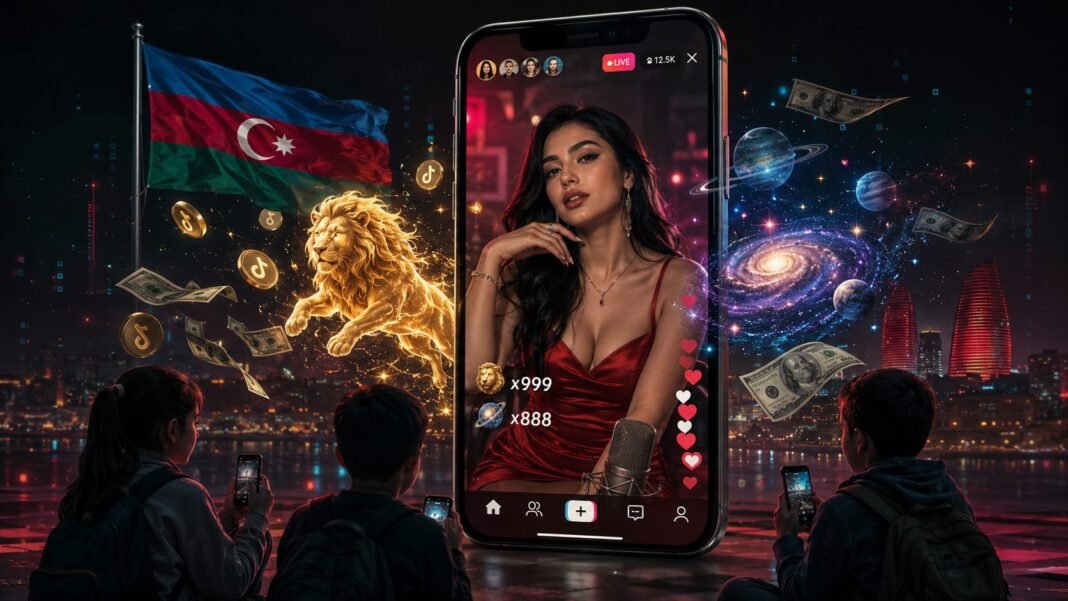
In exchange for a “Lion,” “Universe” or another high-value gift, some donors are promised private conversations, personal meetings or services whose meaning is barely concealed.
Not every such exchange automatically constitutes prostitution. That is a legal determination for law enforcement. But when a virtual gift effectively becomes payment for a subsequent sexual encounter, authorities have a responsibility to investigate whether commercial sexual exploitation is being disguised as online entertainment.
Responsibility should not be placed solely on the women appearing on camera. The platform is the primary beneficiary of the system.
TikTok has created a chain that works like this:
provocation - public competition - emotional pressure - virtual gift - real money.
That is no longer a simple tool for thanking a creator. It increasingly resembles a mixture of an auction, a casino and a digital strip club. The more conflict, exposure, humiliation and suggestive bargaining a stream generates, the more viewers spend - and the platform profits from the transaction.
Under TikTok’s own rules, users must be at least 18 to access coins and send gifts. The effectiveness of that age verification in Azerbaijan, however, is highly questionable.
Children Behind Digital Mustaches
Even a cursory review of Azerbaijan’s TikTok segment reveals accounts whose owners appear to be minors. Some use filters that add mustaches or beards, alter their voices or enter false birth dates to gain access to adult features.
Azerbaijan has now adopted legislation prohibiting children under 16 from opening individual accounts on age-restricted social media platforms. Users between 16 and 18 will require consent from a parent or legal guardian.
The law signed by President Ilham Aliyev requires platforms to verify users’ ages, restrict harmful content and conduct additional checks when a person’s behavior raises reasonable doubts about their declared age.
Published on Aug. 5, 2026, the legislation will take effect 12 months later. But that does not give TikTok a year-long exemption from responsibility. Its own policies already prohibit children under 13 from using the platform and bar minors from the gift economy.
The Azerbaijani legislation also explicitly identifies infinite scrolling and automatic video playback as manipulative design techniques capable of encouraging addictive behavior among teenagers.
The state has effectively acknowledged that TikTok does not merely display content. It is designed to keep children watching.
If a minor can defeat the age protections of a multibillion-dollar technology company by applying a fake beard filter, those protections exist mainly in corporate presentations and press releases.
An Algorithm That Rewards the Worst Behavior
TikTok did not invent vulgarity, ignorance, prostitution, gambling or fraud. But its algorithm has become extraordinarily effective at turning the worst forms of human behavior into profitable content.
A calm, thoughtful conversation rarely goes viral. A scandal, fight, obscenity, sexual provocation or public humiliation has a much better chance.
Creators quickly learn the platform’s real rules: The lower the standards fall, the higher the engagement rises.
TikTok’s own figures illustrate the scale of the problem. During the first three months of 2026, the company removed more than 590,000 videos from its Azerbaijani segment for violating community rules. More than 3.6 million videos were removed during 2025, according to the platform’s enforcement data.
TikTok presents these figures as evidence of effective moderation. They can just as easily be read as evidence of an industrial-scale toxic-content problem.
In July, police in Nakhchivan detained four TikTok users over videos containing obscenities and conduct deemed offensive to public morality. One received 12 days of administrative detention, while the others were fined 500 manats, or about $294, each.
In November 2025, Azerbaijan’s cyber police identified 17 influencers who had promoted prohibited online gambling and betting platforms through TikTok and other social networks.
In another revealing case, the Interior Ministry said a suspect used TikTok to find images of law students, altered them with artificial intelligence, added insulting captions and circulated them through fake accounts. He then allegedly demanded money from the students to remove the material.
This is the ecosystem now operating inside the app: shadow payments, gambling, sexual solicitation, harassment, extortion, minors and a relentless competition for attention.
Arresting People for Obscenities Is Not Enough
Police could detain another 10 or 100 streamers for using obscene language. That would produce several dramatic headlines, but it would not dismantle the system that creates new offenders every day.
Authorities cannot punish only the people visible on the screen while ignoring:
- Coin sellers handling large volumes of money
- Personal bank cards receiving mass commercial payments
- Streamer income omitted from tax declarations
- Possible sexual services exchanged for virtual gifts
- Organizers of illegal gambling promotions
- Accounts operated by minors
- Officials allegedly providing protection
- TikTok itself, which profits from the entire system
Azerbaijan’s State Tax Service, Central Bank, Financial Monitoring Service, Interior Ministry and Prosecutor General’s Office should conduct a joint investigation into the virtual-gift market.
This should not be another selective campaign against a handful of scandalous personalities. It should be a comprehensive audit of the money.
TikTok should be required to disclose:
- The value of coins purchased by users in Azerbaijan
- The total value of gifts sent to Azerbaijani streamers
- Payments made to creators and intermediaries
- The number of accounts blocked for violating age restrictions
- Livestreams terminated for sexual exploitation, gambling or extortion
- The tax treatment of its Azerbaijani operations
The new Azerbaijani law requires covered platforms to register locally and create a contact center accessible in the Azerbaijani language. It also provides for financial penalties, advertising restrictions and, in cases of continued noncompliance, the gradual reduction of a platform’s internet traffic by as much as 90%.
Those provisions must not remain threats on paper.
TikTok Must Choose
This is not yet an argument for an unconditional ban.
TikTok hosts educational projects, entrepreneurs, musicians, journalists and talented creators. Millions of people should not be punished for the conduct of the platform’s most aggressive and destructive users.
But Azerbaijan can no longer treat TikTok as a neutral foreign website.
The company makes money from Azerbaijani users. It influences children, shapes public behavior and operates an opaque virtual-currency market. It must therefore accept the responsibilities expected of any other major business operating in the country.
TikTok should face a simple choice: Become a transparent, law-abiding platform or lose access to the Azerbaijani market.
Azerbaijan is not required to tolerate an unregulated currency exchange, an underground casino, an escort marketplace and a school of public abuse inside a single app merely because they are decorated with music, animation and virtual “Lions.”
AZE.US