AZE.US
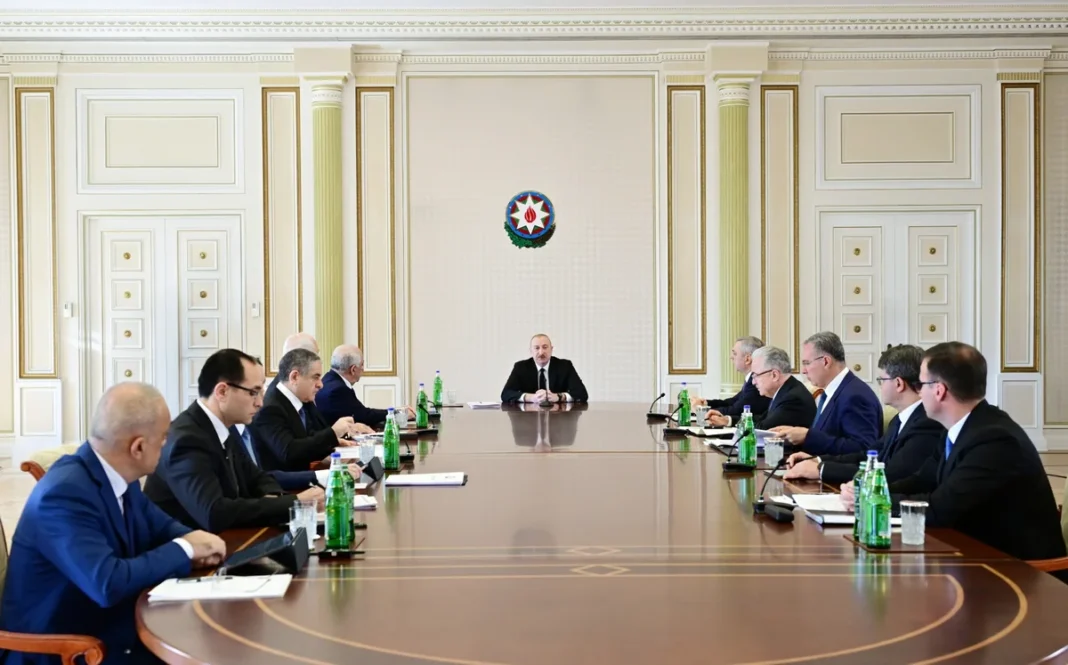
President Ilham Aliyev chaired a meeting on agriculture in Baku, signaling a new policy push aimed at raising domestic food production, reducing import dependence and expanding modern irrigation across Azerbaijan’s farming sector.
The central message was unusually direct: Aliyev said the recent dynamics in agricultural production no longer satisfied him. A new state program for 2026–2030 is now being prepared, with a focus on productivity, water use, processing, food security and private investment.
Preliminary estimates presented at the meeting put the expected investment volume at about 5.9 billion manats. Of that amount, roughly 2.2 billion manats would come through state support, while another 3.7 billion manats is expected from the private sector.
Wheat remains one of the most sensitive issues. Aliyev said Azerbaijan currently covers only 55% of its wheat needs through domestic production. The country produces 1.573 million tons of wheat and imports another 1.267 million tons. He described that level of dependence as unacceptable, while noting that full self-sufficiency in food wheat should not be treated as an absolute target.
The picture is stronger in several other categories. Azerbaijan’s self-sufficiency rate stands at 107% for vegetables, 140% for fruit and berries, 102% for sugar, and the country fully covers domestic egg demand. But dependence remains in meat, poultry, fish, butter and vegetable oils. Self-sufficiency is estimated at 84% for beef, 82% for poultry, 81% for fish and fish products, and only 52% for vegetable oils.
Water was another major theme. Modern irrigation systems currently cover about 130,000 hectares. The new target is to expand that figure to 300,000 hectares. In a country where agriculture is highly exposed to climate shifts and water stress, irrigation is no longer a technical side issue. It is central to productivity, food prices and the long-term viability of farming.
The planned program also calls for expanding intensive orchards by 20,000 hectares, adding 500 hectares of greenhouse capacity, increasing cold-storage capacity to 500,000 tons, and strengthening agricultural processing. The policy logic is clear: Azerbaijan wants to export less raw agricultural output and capture more value through finished or processed products.
Livestock is another priority. The government aims to bring self-sufficiency in meat and poultry to 100% by 2030. Milk production is expected to rise by 10%, meat output by 20%, and poultry production by 30%. Agriculture Minister Majnun Mammadov also pointed to a structural problem: pedigree livestock accounts for only 2.5% of the national herd, limiting productivity.
The meeting effectively marked a shift from an older model based on infrastructure, subsidies and expanded planting toward a more targeted agricultural strategy. The next phase is expected to rely more heavily on modern irrigation, land analysis, technology, processing, export planning and private capital.
For Azerbaijani households, this is not an abstract policy debate. The success or failure of the program will affect prices for bread, meat, potatoes, butter and other basic goods. For farmers, it is about water, machinery, credit and profitability. For the state, it is a test of whether agriculture can become not only a social anchor for the regions, but a stronger part of the non-oil economy.
AZE.US