By AZE.US Editorial Team
Azerbaijan’s recurring argument over child benefits has again been reduced to a familiar line: if the state gives families money, people will become lazy.
That is not a serious economic argument. At this point, it looks more like a sign of political denial.
Because in a country where many young families hesitate to have a second child not out of selfishness but because of housing costs, food prices, medical expenses, childcare and mortgage pressure, child support should not be treated as a handout. It should be discussed as part of a long-term national strategy.
That was the core point made by economist and political figure Natig Jafarli during a recent appearance on Musavat TV. His response was direct: what amount are critics even talking about? 100 manats? 200 manats? Who exactly is supposed to quit working and live off that? His point was simple. Such sums do not create dependency. They barely soften the pressure on a struggling household.
But the real issue runs much deeper.
Jafarli argued that the government should not be looking at child support as a narrow budget item. It should be looking at it through a 10-, 15- and 20-year lens. Birth rates are falling. Young people are leaving the country. Families are delaying children. That has consequences far beyond household budgets.
It affects the future labor force. It affects the pension system. It affects the size of the next generation. It even affects future military manpower.
That is what makes the current debate so striking. Azerbaijan is not really arguing about a benefit. It is arguing about whether the state still has the instinct of self-preservation.
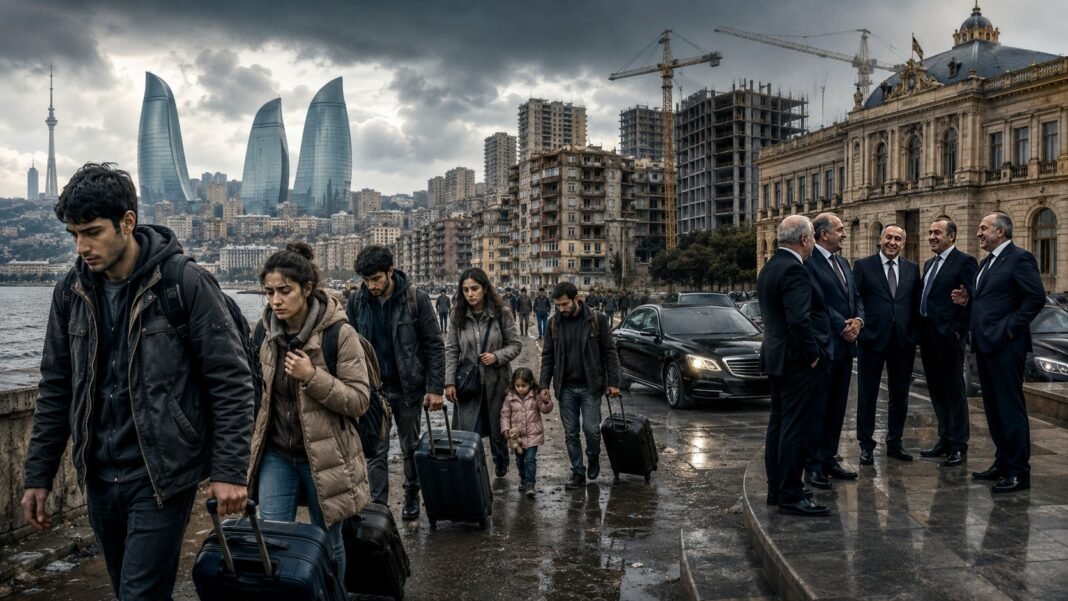
A recent Facebook discussion on the same issue captured the public mood more clearly than many official statements. The comments moved quickly beyond child payments and into the broader reality facing the country: soaring real estate prices, stagnant incomes, weak opportunities for young professionals, pressure on small business, distrust of official macroeconomic figures, and a widespread feeling that the city is becoming more expensive much faster than life is becoming more secure.
One of the strongest lines from that discussion was that young people are studying English not because they suddenly fell in love with Shakespeare, but because “I’m leaving after New Year” has started to sound like a normal life plan.
That is not just social media frustration. It is a warning signal.
In that same discussion, one widely shared post pointed to a set of troubling numbers. According to the text, Azerbaijan registered 121,322 births in 2024 and more than 78,000 abortions. In 2025, births reportedly fell to 96,062, while the number of abortions approached 95,000. Whether every public figure in that debate uses identical wording or emphasis, the broader trend being discussed is hard to ignore: fewer births, growing anxiety and a deepening sense that family life is becoming economically harder to sustain.
Housing sits at the center of that anxiety.
When an apartment that cost 120,000 manats five or six years ago can now be offered at 250,000 to 300,000 manats, often without major upgrades, many young couples stop thinking about family growth and start thinking about survival. A second child becomes not a natural next step, but a financial calculation. A third child starts to look like a luxury.
This is where the “people will become lazy” argument begins to collapse under its own weight.
It allows officials to avoid the harder questions.
Why is decent housing increasingly out of reach for working families?
Why do so many educated young people see their future abroad?
Why do people speak so openly about leaving, even when they still want to love the country they live in?
Why does a state that constantly speaks about the future so often struggle to create basic confidence in everyday life?
Jafarli’s suggestion was not radical. He argued that support could be introduced gradually, perhaps starting with the second child, since the second child is often where many families hit their limit. The first child may still come with help from parents, hope, and emotional momentum. The second forces a more sober calculation: where will the family live, how will it pay, who will care for the child, and what happens if one income disappears?
That is a rational policy discussion.
It is also a much more serious conversation than the theatrical fear that child benefits will turn citizens into idlers.
Support for families does not have to mean simple cash distribution and nothing else. It can include targeted aid for young households, lower costs for infant food and childcare items, better mortgage access, support for second and third children, and housing programs tied to real jobs and functioning infrastructure. It can also include a broader commitment to stop treating family formation as a private burden that the state merely observes from a distance.
Because this is no longer just about social policy.
A country with falling birth rates, expensive housing and outward migration cannot forever hide behind headline population growth or polished growth statistics. Official demographic expansion means little if the most active, educated and economically productive part of society is steadily looking for the exit.
When a young person leaves, the country does not lose only one citizen. It loses future taxes, future children, future demand, future skills and part of the social base that will one day be expected to support an aging population.
Azerbaijan still has time to respond. But not much of it should be wasted on empty slogans.
Children do not arrive because of official optimism. They arrive where families have space, income, predictability and some sense that the state sees them not as petitioners, but as the foundation of the country’s future.
That is why the child benefits debate matters.
It is not about whether 100 or 200 manats will make people lazy.
It is about whether the state understands that demography cannot be fixed with speeches, and that no serious country can afford to treat young families as an afterthought.
If Azerbaijan wants a future that is more than a set of annual reports, it will have to stop arguing about child support as if it were a burden and start treating family support as what it really is: an investment in national survival.
AZE.US