By AZE.US Editorial Team
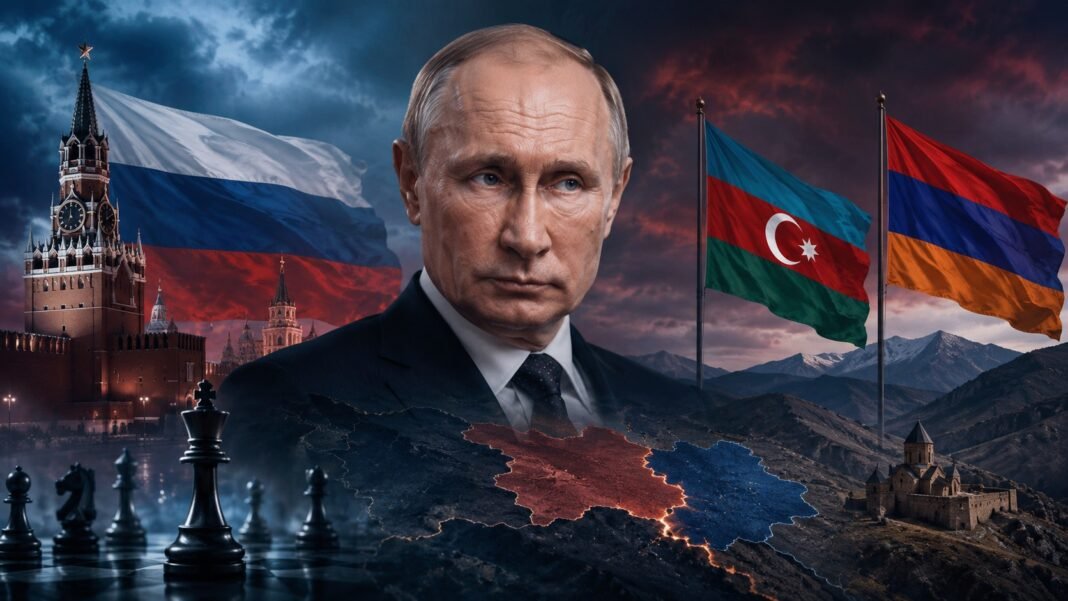
Russian President Vladimir Putin has signed a law allowing the country’s armed forces to be used abroad to protect Russian citizens, Interfax reported.
Formally, the law concerns cases in which Russian citizens are arrested, detained, prosecuted or otherwise targeted under decisions by foreign courts, international judicial bodies or institutions whose authority Moscow does not recognize as binding on Russia.
On paper, this is a legal amendment. In real politics, laws of this kind rarely remain only legal language.
For Azerbaijan and Armenia, the message is not that Russian forces are about to move into the South Caucasus tomorrow under the banner of “protecting citizens.” The text itself does not create such an automatic scenario.
But it does create something else: another legal pretext through which Moscow can frame pressure on neighboring states.
Russia has long used the language of protecting its citizens and compatriots as part of its foreign policy toolkit. Now that language is being further formalized. Not as a Foreign Ministry statement. Not as television rhetoric. Not as an emotional response to a crisis. As a legal mechanism that can be activated by the Russian president.
For Azerbaijan, this matters for several reasons.
First, Baku has moved beyond the old Karabakh framework. After Azerbaijan restored control over Karabakh and Russian peacekeepers left the region, Moscow lost one of its most convenient physical levers inside Azerbaijan’s security space. Against that background, any new Russian tool of extraterritorial pressure cannot be dismissed as a purely domestic Russian matter.
Second, Russian citizens, business figures, former officials, media personalities, activists and people involved in different legal cases can be present anywhere in the region, including the South Caucasus. If one of them comes under criminal investigation in a regional state, Moscow now has another ready-made formula: this is not only a local legal matter, but a case involving the protection of a Russian citizen.
That is where the issue becomes politically slippery.
Azerbaijan does not treat dual citizenship as an ordinary legal status. From Baku’s point of view, a person on Azerbaijani territory is subject to Azerbaijani law. But Moscow may look at the same person through a different lens: if Russia considers that person a Russian citizen, it can claim a political responsibility to defend them.
This does not mean the new law is aimed directly at Azerbaijan. But it creates a background. And in regional politics, background often matters almost as much as a direct threat.
For Armenia, the matter is even more sensitive.
Unlike Azerbaijan, Armenia still lives with a long history of direct Russian military presence. The Russian base in Gyumri, the role of Russian border guards and Moscow’s wider security footprint have shaped Armenia’s sovereignty for decades.
Even as Yerevan tries to reduce its dependence on Moscow and move closer to Western partners, it cannot simply switch off that legacy overnight. Prime Minister Nikol Pashinyan’s government has already frozen Armenia’s participation in the CSTO, accusing the Russian-led security bloc of failing to protect Armenia at critical moments. But Armenia remains exposed to Russian pressure through security, economics, media influence and domestic political networks.
In that context, Moscow’s new law sounds less abstract for Yerevan than it does for Baku.
Armenia has Russian citizens, Russian-linked structures, Russian military personnel and Russian-connected political interests on its territory. In such an environment, “protecting citizens” can become more than a humanitarian phrase. It can become a political brake on any Armenian government trying to act too independently.
For Azerbaijan, the main conclusion is different: Baku has to guard its sovereignty with even greater discipline.
There is no need to dramatize the law or pretend it was written specifically against Azerbaijan. But there is also no reason to ignore it. In Russian political practice, such formulas can become part of a larger sequence: first legal language, then diplomatic pressure, then a media campaign, and then claims of “extraordinary circumstances.”
The South Caucasus has seen versions of this before. Different slogans, different passports, same basic method.
Azerbaijan’s position should be clear: Russian citizenship must not become a zone of immunity inside Azerbaijani jurisdiction. Anyone on Azerbaijani territory should be subject to Azerbaijani law.
That message does not need to be loud. It needs to be firm.
For Armenia, the question is sharper: can the country build a sovereign political order while Russian military, passport and institutional presence remain available as instruments of internal and external pressure?
That is why the law should not be read only as a Moscow legal update. It belongs to a broader Russian architecture shaped by the war in Ukraine, sanctions, international investigations and Moscow’s confrontation with Western judicial institutions. Russia is creating mechanisms to reject outside jurisdiction over its citizens and, if it chooses, to answer in the language of force.
For the South Caucasus, the meaning is simple: the era of post-Soviet ambiguity is not over. It has become more legally structured.
Moscow increasingly speaks not in the language of partnership, but in the language of rights to intervene. Today, it is the protection of citizens. Tomorrow, it can be the protection of historical memory, security, transport routes, borders or “compatriots.”
Azerbaijan and Armenia should read the signal differently, but the conclusion is the same for both: the more external legal pretexts exist in the region, the less space remains for real sovereignty.
For Baku, which is trying to consolidate full independence after Karabakh, and for Yerevan, which is trying to loosen Russia’s grip, the new law is a reminder that sovereignty in the South Caucasus is no longer contested only at borders or negotiating tables.
It is also contested through passports, courts, legal formulas and clauses that may one day be used as political pressure.
AZE.US