By AZE.US
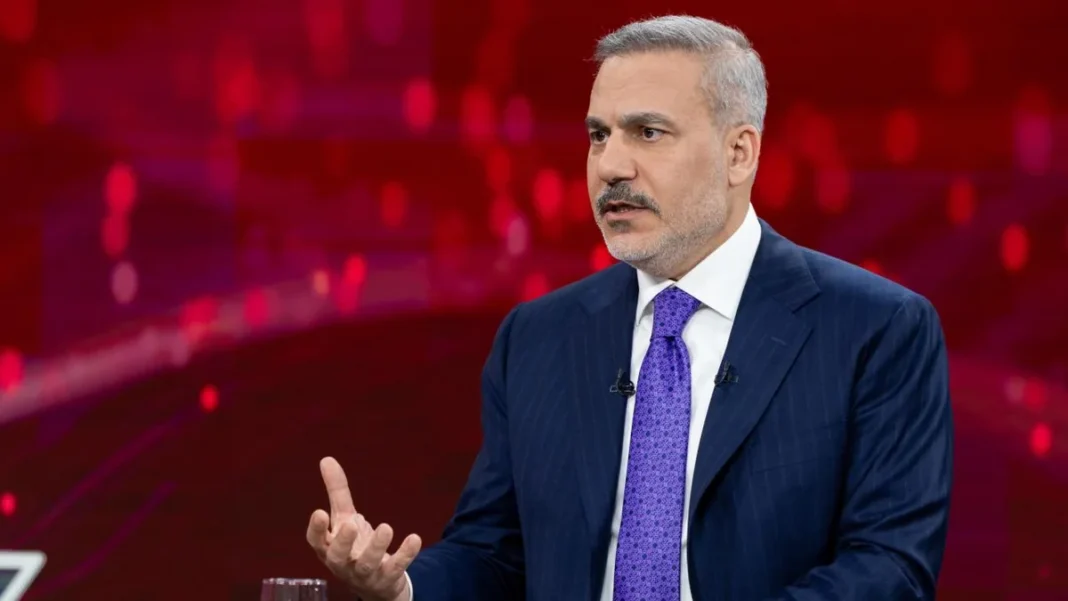
Turkish Foreign Minister Hakan Fidan is visiting Azerbaijan on Sept. 15-16 for talks expected to focus on regional security, the Azerbaijan-Armenia peace process, energy cooperation and the two countries’ goal of increasing annual trade to $15 billion.
Türkiye’s Foreign Ministry officially announced the visit on Sept. 14. Fidan is expected to meet Azerbaijani Foreign Minister Jeyhun Bayramov and be received by President Ilham Aliyev, according to Turkish media reports.
The visit comes as Baku and Ankara coordinate their positions on several rapidly developing regional issues, including new transportation routes, postwar security arrangements and the normalization process between Azerbaijan and Armenia.
Azerbaijan and Türkiye describe their relationship as an allied partnership. The 2021 Shusha Declaration formally expanded cooperation in defense, foreign policy, energy, transportation and economic development.
Security is expected to remain high on Fidan’s agenda. The two countries conduct joint military exercises and maintain close coordination between their armed forces and defense industries.
The discussions are also likely to address the next stage of the Azerbaijan-Armenia peace process. Türkiye has tied full normalization with Armenia to progress between Baku and Yerevan, although Ankara and Yerevan have maintained a separate diplomatic channel.
Transportation is another central issue. Azerbaijan and Türkiye support the opening of an uninterrupted connection between mainland Azerbaijan and the Nakhchivan Autonomous Republic, with onward access to Türkiye.
Any new route would have consequences extending beyond bilateral relations. It could strengthen east-west trade links connecting Central Asia, the South Caucasus, Türkiye and European markets.
Energy cooperation already provides the economic backbone of the Azerbaijani-Turkish alliance. The Baku-Tbilisi-Ceyhan oil pipeline, Baku-Tbilisi-Erzurum gas pipeline and Trans-Anatolian Natural Gas Pipeline have turned the partnership into an important component of European energy security.
Baku and Ankara are now seeking to broaden cooperation beyond traditional oil and gas projects. Electricity transmission, renewable energy, defense production, logistics and reconstruction projects are increasingly prominent parts of the bilateral agenda.
Annual trade between Azerbaijan and Türkiye currently stands at approximately $7 billion. The two governments have set a target of $15 billion, but reaching it will require greater private investment, improved transport capacity and deeper integration between the two economies.
The visit is therefore not simply another demonstration of political solidarity. It is an opportunity to assess whether ambitious strategic declarations are being converted into commercial projects and regional infrastructure.
Fidan’s talks may also provide indications of how Baku and Ankara view the balance of power in the South Caucasus at a time when Armenia is diversifying its foreign relationships and Russia’s traditional regional role is changing.
No major agreements had been announced before the meetings began. The practical results of the visit – including any decisions on trade, transportation or security – will become clearer after the talks.
What is already evident is that Azerbaijan and Türkiye see the present moment as an opportunity to shape the region’s next political and economic framework together.
AZE.US