AZE.US
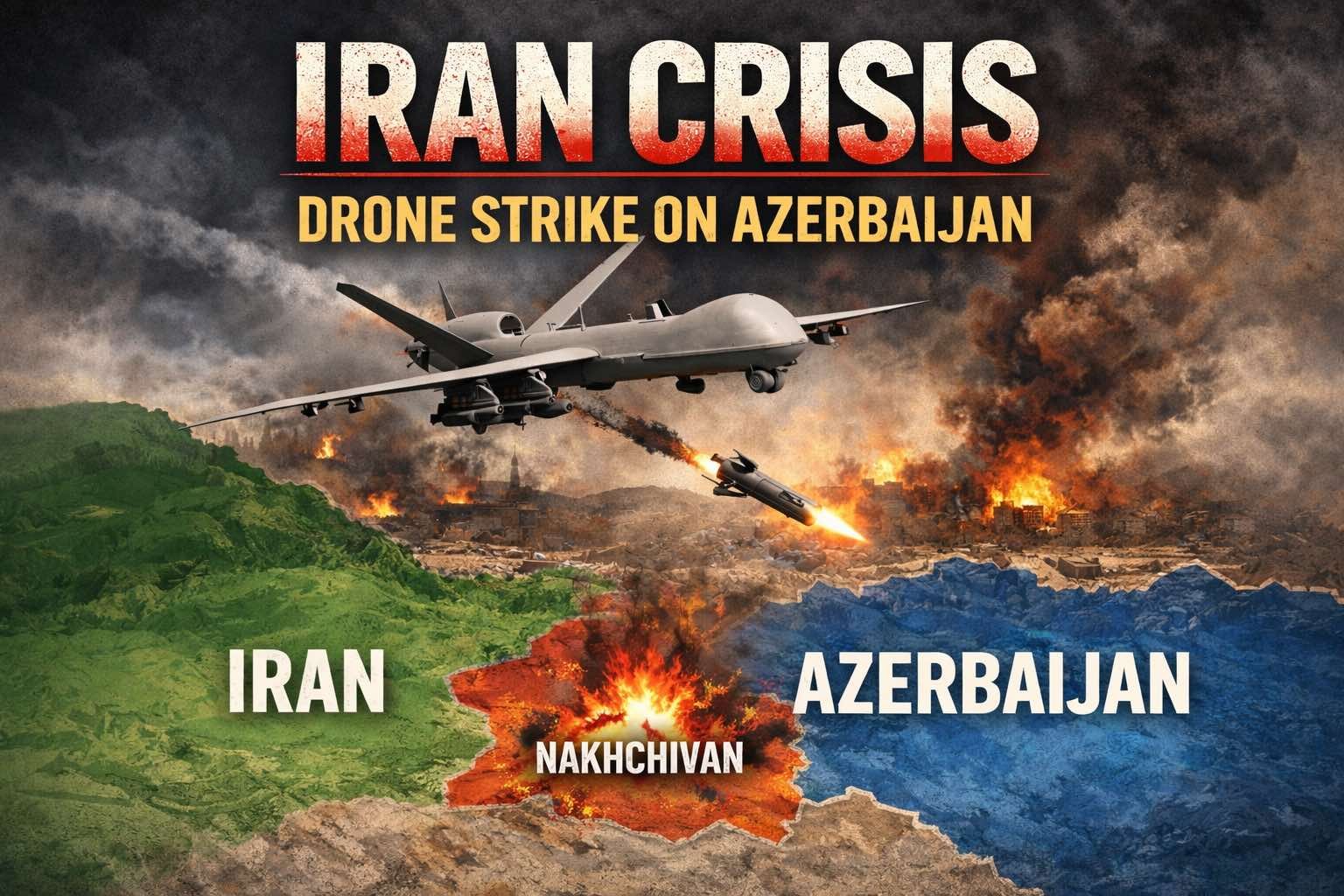
The drone strike on Azerbaijan’s Nakhchivan exclave may look like a small incident in a region already saturated with crises. Two drones hit civilian sites, damaging the terminal building of Nakhchivan International Airport and landing near a school in the Babek district village of Shakarabad.
Several civilians were injured. Windows were shattered. Parts of the building were damaged.
But the real significance of the incident lies elsewhere.
For the first time during the current wave of tensions surrounding Iran, Azerbaijani territory has been directly struck.
That fact alone forces a difficult question: was this a calculated signal from Tehran – or a sign that control inside Iran is weakening?
A Strange Target
If the attack was intentional, the choice of target is puzzling.
Azerbaijan has not positioned itself as an adversary in the current confrontation around Iran. On the contrary, Baku has repeatedly stated that its territory will not be used against neighboring states. President Ilham Aliyev even personally visited the Iranian embassy in Baku to offer condolences after recent developments in Iran – a gesture few other regional leaders made.
Turkey, Azerbaijan’s closest ally, has taken a similarly cautious approach.
In other words, Azerbaijan has tried to stay outside the confrontation.
That is what makes the strike on Nakhchivan so unusual.
Launching a direct attack on a country that is trying to remain neutral would be strategically irrational – especially for a government already facing intense pressure in the region.
The More Troubling Possibility
There is another explanation.
The attack may not have been a carefully coordinated decision by Iran’s central leadership at all.
Iran’s political system is not a single chain of command. It is a complex and often fragmented structure in which several powerful institutions operate simultaneously – including the Islamic Revolutionary Guard Corps, various security bodies and competing political factions.
In stable times those structures can function together.
In moments of crisis, they can begin to pull in different directions.
If armed units begin acting independently – whether to demonstrate strength or to gain leverage in internal power struggles – the consequences can spill across borders.
That scenario may be more worrying than a deliberate attack.
Because it would mean that the region is dealing not with a predictable state actor, but with a system where the line between central authority and autonomous military action is increasingly blurred.
Why Nakhchivan Matters
The location of the strike adds another layer of significance.
Nakhchivan is not just any region of Azerbaijan. It is a strategic exclave bordering Iran, Turkey and Armenia – a geopolitical crossroads where even a small incident can quickly acquire regional implications.
Turkey and Azerbaijan maintain a close strategic partnership and security cooperation. Any escalation in Nakhchivan therefore carries the potential to involve a broader set of actors.
For Iran, already facing pressure on multiple fronts, opening a confrontation with both Azerbaijan and Turkey would make little strategic sense.
Which again points back to the possibility that the strike was not part of a carefully planned geopolitical move.
A Glimpse Of What Could Come
For now, the damage in Nakhchivan is limited.
But the event may represent something more important than the attack itself.
It may be an early signal that the instability surrounding Iran is beginning to ripple outward.
When states experience internal fragmentation, external incidents often become the first visible symptom. Small confrontations appear at the margins – miscalculated actions, unauthorized operations, or signals sent by factions seeking to prove their relevance.
History shows that such moments can quickly spiral into wider crises.
For Azerbaijan, the immediate task is to defend its territory while avoiding an escalation that could draw the South Caucasus into the larger turbulence surrounding Iran.
But the bigger question will not disappear.
If Iran’s internal system becomes more unstable, the region may soon face a far more unpredictable neighbor than before.