By AZE.US Editorial Team
Armenia’s new government looks almost identical to the old one. That is precisely the point.
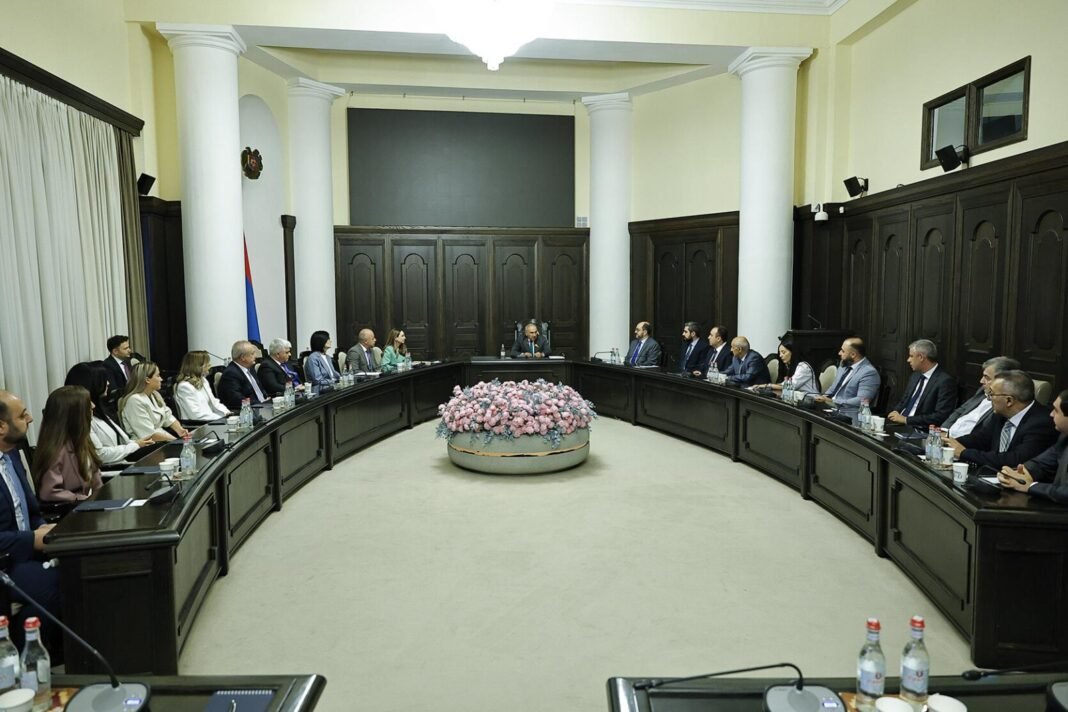
After his Civil Contract party won the June 7 parliamentary election, Nikol Pashinyan was reappointed prime minister by President Vahagn Khachaturyan on Aug. 2. A day later, the president formalized the new Cabinet on Pashinyan’s recommendation.
Of Armenia’s 12 ministers, only one was replaced. Mkhitar Hayrapetyan left the Ministry of High-Tech Industry and was succeeded by Davit Tadevosyan.
Foreign Minister Ararat Mirzoyan, Defense Minister Suren Papikyan, Interior Minister Arpine Sargsyan, Economy Minister Gevorg Papoyan and Finance Minister Vahe Hovhannisyan all retained their positions. Deputy prime ministers Mher Grigoryan and Tigran Khachatryan were also reappointed.
There was no Cabinet purge and no attempt to present a new ideological course. Instead, Pashinyan chose continuity before a politically difficult period involving the unsigned peace agreement with Azerbaijan, normalization with Türkiye, a planned constitutional referendum and Armenia’s increasingly complicated relationship with Russia.
The Real Changes Happened Outside the Cabinet
The most important personnel changes took place around the government rather than inside it.
Ruben Rubinyan was elected speaker of Armenia’s new National Assembly, replacing Alen Simonyan. Rubinyan received 63 votes in favor and 28 against, with 91 of the parliament’s 105 members participating.
Rubinyan has served as Armenia’s special representative in normalization talks with Türkiye since 2021. His election as parliament speaker does not turn the legislature into a foreign-policy agency, but it elevates a politician closely associated with the Turkish track at a time when Yerevan views the opening of its western border as part of a broader regional peace strategy.
Simonyan lost to Rubinyan in an internal Civil Contract vote and later declined to take his seat in the new parliament.
Speculation has already emerged that Simonyan could eventually be offered the presidency or tasked with creating a more moderate opposition force. There is no confirmed evidence for either scenario. His departure currently looks more like controlled political rotation and an assertion of party discipline than the beginning of a new political project.
The second major appointment was Lilit Makunts as chief of staff of the Prime Minister’s Office.
Makunts previously served as culture minister, parliamentary faction leader and Armenia’s ambassador to the United States from 2021 to 2025. Her appointment to Pashinyan’s inner administration strengthens a politician with extensive Washington experience at the center of executive decision-making.
She replaces Arayik Harutyunyan, who moved to parliament after the election.
Taken together, the two appointments suggest that Pashinyan is not changing Armenia’s policy but reorganizing the institutions responsible for delivering it. Rubinyan takes control of the parliamentary agenda, while Makunts moves into the administrative center of the prime minister’s office.
Peace With Azerbaijan Remains the Central Test
The decision to retain Mirzoyan, Papikyan and the two deputy prime ministers signals continuity in foreign, defense and economic policy.
Armenia and Azerbaijan initialed the text of a peace agreement in Washington in August 2025, but the document has not yet been formally signed and ratified.
Baku continues to insist that Armenia remove language that Azerbaijan considers an implicit territorial claim. The dispute centers on the Armenian Constitution’s preamble, which references the 1990 Declaration of Independence. That declaration, in turn, cites a 1989 resolution calling for the unification of Soviet Armenia and the former Nagorno-Karabakh autonomous region.
Yerevan disputes Baku’s interpretation, but Pashinyan has repeatedly promised to propose a new constitution. He previously said the referendum was planned for 2027.
The main obstacle is no longer the government’s intentions. It is parliamentary arithmetic.
Civil Contract holds 64 of the 105 seats in the new National Assembly. Calling a constitutional referendum requires a two-thirds majority, or at least 70 votes.
Pashinyan is therefore six votes short.
This is the central weakness in his post-election position. His party has enough seats to govern but not enough to unilaterally launch the referendum that could remove the final political obstacle to a peace treaty with Azerbaijan.
The main opposition forces, Strong Armenia and the Armenia Alliance, campaigned against Pashinyan’s peace framework and accused him of making excessive concessions to Baku. Securing their support for constitutional change will be difficult.
The election therefore produced a paradox: it confirmed Pashinyan’s mandate to continue his peace policy while complicating his ability to complete the constitutional process.
Armenia Faces Two Different Referendum Questions
The proposed vote on a new constitution should not be confused with a possible referendum on Armenia’s geopolitical orientation.
Moscow has been pressing Yerevan to clarify whether it intends to pursue European Union membership or remain fully integrated into the Russian-led Eurasian Economic Union.
In late July, Russian President Vladimir Putin told Pashinyan that Armenia’s EU ambitions should be put to a referendum as soon as possible. The message came as Russia imposed restrictions on several categories of Armenian exports.
Pashinyan subsequently asked Putin to intervene, arguing that the restrictions violated bilateral agreements and EAEU rules.
Russia still accounts for about 35% of Armenia’s foreign trade and remains a crucial energy supplier. This dependence explains why Pashinyan’s Western pivot has not become an immediate break with Moscow.
His government will continue expanding ties with the United States and the European Union while attempting to avoid a Russian economic shock. Retaining most of the Cabinet reflects that strategy of controlled movement rather than sudden rupture.
A Stable Cabinet With Radical Tasks
Armenia’s new government will not transform the country simply by taking office. Most of its members have already been implementing Pashinyan’s policies for years.
The larger transformation will depend on whether the prime minister can turn 64 parliamentary seats into the 70 votes needed for a referendum, convert the initialed document into a final peace treaty with Azerbaijan, turn talks with Türkiye into an open border and translate Western political support into investment and economic growth.
Pashinyan has kept his ministers because he does not intend to change direction. But he has altered the political structure around them, placing Rubinyan in parliament and Makunts at the center of his administration.
The Cabinet is stable. The agenda before it is anything but.
AZE.US