AZE.US
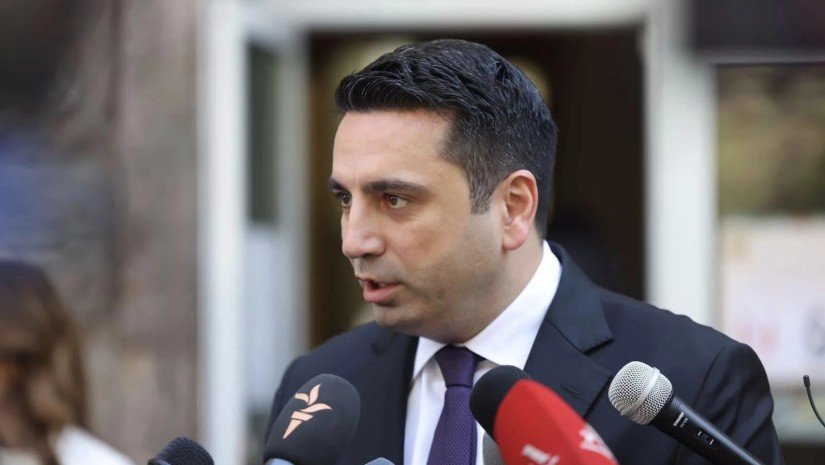
Armenian parliament speaker Alen Simonyan has said peace with Azerbaijan is no longer only a diplomatic issue, but part of Armenia’s new understanding of independence, sovereignty and survival as a state.
Speaking in a wide-ranging interview on Radio Van channel one week before Armenia’s parliamentary elections on June 7, Simonyan said the country had passed through war, political trauma and disillusionment with old security arrangements, but now had to define where Armenia begins and ends.
His message was unusually direct for Armenian politics: Armenia, he said, must stop living inside an inherited historical and geopolitical trap and start acting as a state with recognized borders, independent choices and normal relations with its neighbors.
Simonyan said the Armenian government was not misleading voters when it spoke about peace. He pointed to the fact that, according to him, no one has died on Armenia’s borders for two years, and said the peace treaty with Azerbaijan had been agreed and was ready for signing.
He also said Armenia and Azerbaijan had already fixed part of their border and were restoring it on the basis of Soviet-era maps under which both countries became independent.
The remarks come at a sensitive moment for Armenia, where the election campaign has again brought the question of Azerbaijan, borders and sovereignty into the center of domestic politics.
Simonyan rejected opposition claims that the authorities were preparing to bring 300,000 Azerbaijanis into Armenia. He described such allegations as deliberate fear politics and said opponents would have to answer after the election when those claims fail to materialize.
The speaker also framed the election as a choice between two models of statehood.
One model, he said, treats Armenia as a country unable to exist independently and therefore dependent on an outside patron. The other, according to Simonyan, is based on the idea that Armenia can work with Russia, France, Turkey, Azerbaijan and other neighbors without looking for a “big brother.”
He said Armenia does not want to replace one external moderator with another.
That line was clearly aimed at both Russia and Armenia’s pro-Russian opposition. Simonyan said Yerevan was not planning to cut economic ties with Moscow, enter new military alliances or turn itself into a tool of another power. But he also said the old security system had failed Armenia.
Simonyan argued that Russia’s role as the main moderator in the South Caucasus did not prevent the 2020 war or later developments in Karabakh. He said Russian peacekeepers did not stop the shooting in Nagorno-Karabakh and that many Armenians still struggle to accept what happened.
At the same time, he avoided putting all responsibility on Russia. Simonyan said Armenia itself had failed for too long to understand the nature of the Karabakh issue, why it remained frozen and how it kept both Armenians and Azerbaijanis under pressure.
He described Karabakh as a “Damocles’ sword” over both peoples. That phrase may be one of the most politically revealing parts of the interview.
For years, Armenian public discourse treated Karabakh almost entirely as an Armenian tragedy and national cause. Simonyan’s statement acknowledged that the unresolved conflict also hung over Azerbaijanis and helped keep the wider region dependent on outside management.
In his telling, peace with Azerbaijan is therefore not a concession forced on Armenia, but a condition for Armenia to become fully independent.
Simonyan also spoke about the proposed TRIPP project involving Armenia and the United States, presenting it as a business and regional connectivity initiative rather than a military or anti-Russian arrangement. He said it would not violate Armenia’s territorial integrity, bring in foreign troops or hand over Armenian sovereignty.
For Baku, the interview is notable because it shows how far the Armenian government’s language has shifted since the Second Karabakh War. Simonyan did not speak in the language of revanchism. He spoke about borders, trade, regional transport, sovereignty and the need to move beyond the old conflict architecture.
That does not mean Armenian society has accepted this shift easily.
Simonyan admitted that peace with Azerbaijan is emotionally difficult for Armenians. He spoke about historical memory, war, family trauma and the pain of seeing Azerbaijani flags near areas many Armenians once associated with their own personal or family history.
But he said Armenia had to answer a more basic question: where is its home?
His argument was that a country cannot grow, defend itself or build a future if it refuses to define its actual borders. “To become more, we need to fix where our home is,” he said in substance.
That is the core of the political message.
Peace with Azerbaijan, in Simonyan’s version, is not only about ending a conflict. It is about ending Armenia’s dependence on permanent crisis, outside mediators and old slogans that made the country easier to control.
He also said the 2018 revolution did not make Armenians love each other more, but it made them freer. That freedom, he argued, cannot now be put back into a box.
For Armenia’s government, the June election is therefore not just a vote on Prime Minister Nikol Pashinyan’s team. It is a vote on whether Armenian society is ready to accept the post-Karabakh reality and build its independence around state borders, regional peace and a more balanced foreign policy.
For Azerbaijan, the interview offers a rare view into how the peace process is being defended inside Armenia: not as surrender, but as the foundation of a different Armenian state.
Whether that argument wins at the ballot box will shape not only Armenia’s future, but also the next phase of the South Caucasus after decades of conflict.
AZE.US