By AZE.US Editorial Team
Negotiations with Moscow can continue indefinitely. Meetings may follow meetings, envoys may travel between capitals, and all sides may promise to keep talking.
But diplomacy does not necessarily mean that a settlement is getting closer. Sometimes negotiations are used to buy time, preserve leverage and prevent the other side from changing course.
Ukrainian political commentator Vitaly Portnikov sees that pattern in both the latest Russia-Ukraine contacts and the deepening crisis between Moscow and Yerevan.
The two cases are fundamentally different. One involves a full-scale war; the other centers on the gradual collapse of a decades-old alliance. Yet both raise the same question: Can a former Soviet republic pursue an independent foreign policy when Moscow considers it part of Russia’s sphere of influence?
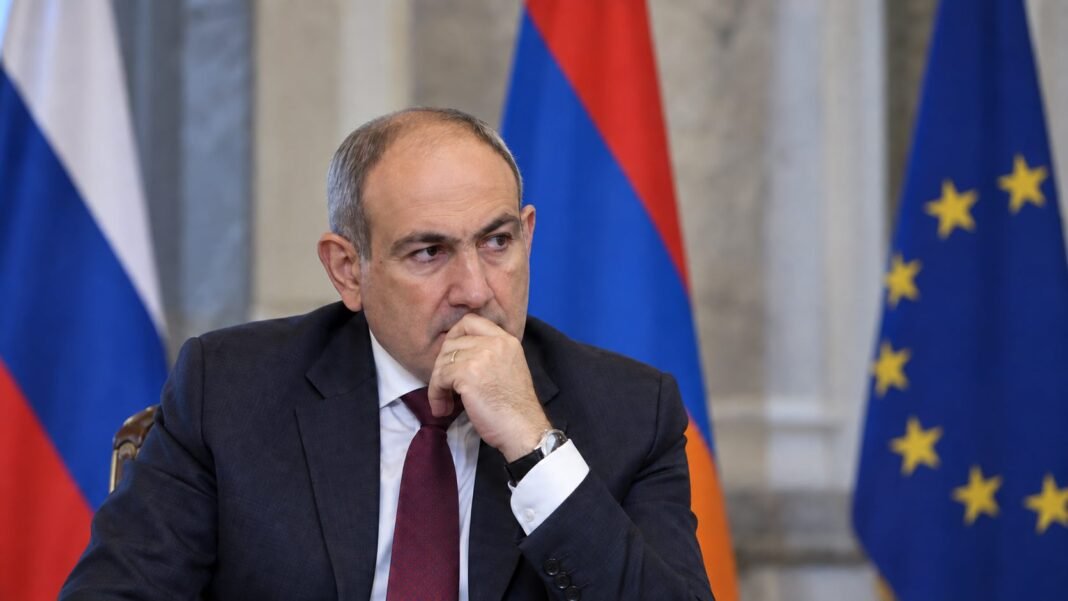
For years, Armenia tried to combine incompatible policies. It remained Russia’s military ally, participated in Moscow-led organizations and relied heavily on Russian trade, energy and infrastructure while simultaneously expanding ties with Europe.
That balancing act appeared useful as long as Armenia was not forced to make a final choice. But a multivector policy works only when every partner accepts a smaller country’s right to maintain several relationships. If one power treats cooperation with a rival as betrayal, the room for maneuver eventually disappears.
Armenia has now reached that point.
Moscow wants clarity about Armenia’s future in the Eurasian Economic Union, the Russian military base in Gyumri and other pillars of Russian influence. Moving toward the European Union, meanwhile, would require Armenia to gradually transform its laws, trade policy, security arrangements and system of governance.
Yerevan cannot continue moving in two opposite directions indefinitely.
However, Ukraine’s experience should not be applied mechanically to Armenia. The differences are enormous. Armenia remains deeply connected to Russia through trade, energy, infrastructure and employment. An abrupt break without credible alternatives could create serious economic and social disruption.
The real question is therefore not whether Armenia should close the Russian base tomorrow and seek EU membership the following day. It is whether Yerevan is prepared to build the institutions, transport routes and international relationships necessary to make decisions without Moscow’s permission.
This is where normalization with Azerbaijan becomes much more than a bilateral matter.
Without peace with Azerbaijan, open regional communications and normalized relations with Turkey, Armenia will remain geographically and economically vulnerable. The fewer roads, markets and partners available to the country, the greater its dependence on Russia will be.
In that sense, peace with Baku is not a concession to Moscow, Brussels or Washington. It is a prerequisite for Armenian sovereignty.
Restored railways, new regional transport links and the TRIPP route are not merely economic projects. They represent the infrastructure of a new political order in the South Caucasus.
Every open road reduces the region’s reliance on a single center of power. Every restored railway creates another option for trade. The ability to choose among several routes gives a country something no political declaration can provide: practical independence.
Azerbaijan followed its own path toward that independence. Baku did not turn its distancing from Moscow into an ideological campaign. Instead, it spent decades developing energy routes that bypass Russia, strengthening its alliance with Turkey and expanding relations with Europe, the United States, China and Central Asia while maintaining working contacts with Moscow.
Most importantly, Azerbaijan never formally accepted Russia’s right to determine its foreign policy.
Baku’s autonomy did not emerge overnight. It was supported by energy resources, transport infrastructure, military capacity and a diversified network of international partnerships.
Armenia will have to do its own work. Anti-Russian rhetoric alone will not make the country independent. Loud political statements without economic and institutional preparation could instead leave it even more vulnerable.
Yet endless negotiations with Moscow are not a safe strategy either. Every new round of talks could become another reason to postpone decisions on railways, regional routes, European integration and security reform.
Portnikov highlights a dangerous pattern: concessions do not always reduce pressure. They can convince a stronger power that coercion is working and should be intensified. At the same time, confrontation for its own sake offers no guarantee of success.
Yerevan needs a strategy, not an emotional break. That strategy should include a peace treaty with Azerbaijan, normalization with Turkey, reopened railways, diversified energy supplies, access to new markets and a gradual reduction of dependence on Russian-controlled structures.
The outcome also matters to Azerbaijan.
Baku has little interest in seeing Armenia become a battleground between Russia and the West. An unstable neighbor whose policies are determined by outside powers presents a greater risk than an independent and predictable state capable of honoring agreements.
Independence, however, also requires responsibility. Armenia cannot demand full sovereignty from Russia while leaving territorial claims against its neighbors unresolved. A European future begins not with an EU flag outside a government building, but with recognition of existing borders and a willingness to coexist peacefully with Azerbaijan and Turkey.
The era in which Yerevan could seek security guarantees from Moscow, financial support from the West and closer ties with Europe while avoiding a strategic choice is nearing its end.
Armenia must now decide whether it wants to remain an object of other powers’ policies or become a state capable of determining its own future.
Its first practical step toward that future does not run through Moscow or Brussels. It runs through peace with Baku.
AZE.US