By AZE.US
Azerbaijanis could be allowed to temporarily access part of the money recorded in their individual pension accounts under a proposal aimed at providing an alternative to high-interest consumer loans.
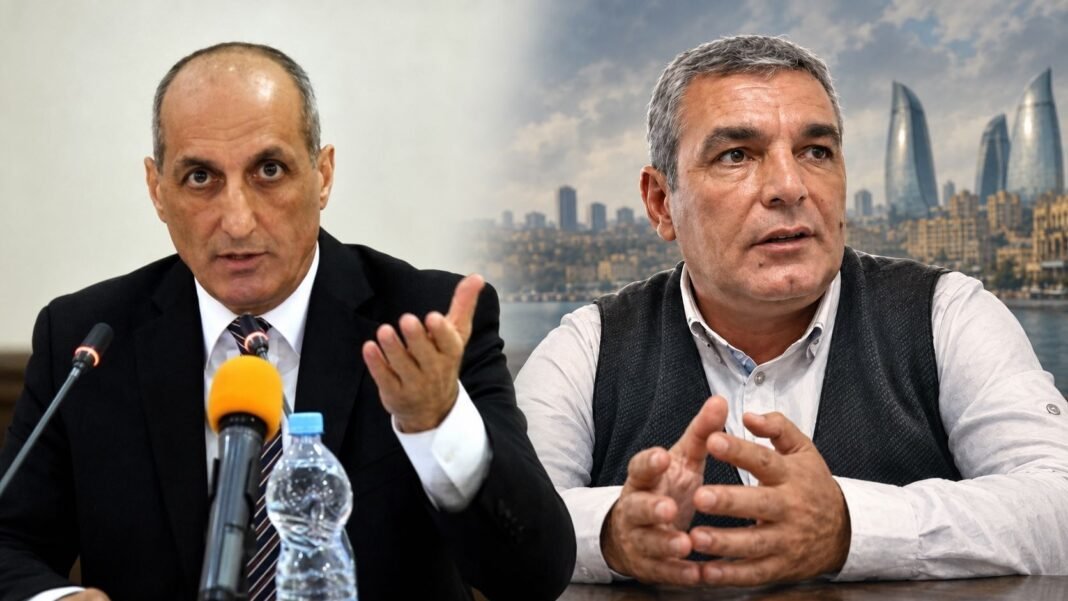
Economist Natig Jafarli outlined the idea during the “Red Table” program on Prime Time Azerbaijan. Former Finance Minister Fikret Yusifov supported calls for the government to clarify who legally owns the accumulated funds and what happens to them when an insured person dies before retirement.
Jafarli said people who urgently need 5,000–10,000 manats currently have little choice but to turn to banks, where consumer loan rates can reach 16–20% annually. At the same time, a much larger amount may be recorded as pension capital in that person’s individual account with Azerbaijan’s State Social Protection Fund.
He proposed a mechanism that would effectively allow citizens to borrow from themselves: withdraw a limited portion of their pension capital and repay it to the same account through monthly installments.
“Suppose 50,000 manats is recorded in my State Social Protection Fund account. Why should I borrow 10,000 manats from a bank at 16-18%? Let me use my own money without interest and repay it to the account within a year,” Jafarli said.
Loans at 0-1%
Under the proposed model, the State Social Protection Fund could establish a joint lending mechanism with commercial banks. The loans would carry either no interest or a rate of about 1%, intended only to cover the financial institution’s operating costs.
The borrower would remain obligated to repay the full amount. For example, a 5,000-manat loan could be returned through monthly payments of 300-400 manats. Once repaid, the entire amount would again be reflected in the citizen’s pension capital.
Jafarli stressed that the proposal does not involve permanently withdrawing pension savings or receiving a pension early. Instead, it would operate as a short-term loan secured by the individual account.
He said the mechanism could offer relief when families need money for tuition, medical treatment or other urgent expenses without forcing them to accept expensive consumer credit.
Who Owns the Money?
The discussion also raised a broader question: whether the funds recorded in an individual pension account are the citizen’s personal property or simply an accounting figure used to calculate a future pension.
Jafarli argued that the public has not received a sufficiently clear answer. He noted that officials have described the current system as one based on intergenerational solidarity, in which contributions from today’s workers finance payments to current pensioners.
That model could come under increasing pressure as Azerbaijan’s population ages, he warned. If the number of pensioners rises while the working-age population and the number of contributors decline, the burden on the system would grow.
“If this money belongs to me, let me use it. If it does not, then explain clearly whose capital it is and what rights the citizen has,” Jafarli said.
He suggested that citizens could at least be granted access to pension capital exceeding the minimum amount required to establish pension entitlement. A benchmark of 46,800 manats was mentioned during the discussion, although any eligibility threshold and repayment rules would require separate legislation.
What Happens After a Person Dies?
The experts separately questioned what happens to pension capital when someone dies before reaching retirement age. They cited the example of a person who had accumulated about 30,000 manats by age 40 or 45 but never lived long enough to exercise pension rights.
They called on the Ministry of Labor and Social Protection to explain whether such funds can be inherited and whether a spouse or other family members acquire additional payment rights.
Yusifov agreed that the issue should be examined through the principles of property rights and transparency. The debate, therefore, extends beyond the proposed low-cost loan mechanism: citizens also need a clear explanation of the legal status of pension capital, the conditions for accessing it and the fate of the funds after an account holder’s death.
The plan remains an expert proposal. Its implementation would require legislative changes, risk-assessment rules and guarantees that temporary access to the funds would not reduce a citizen’s future pension.
AZE.US