By AZE.US Editorial Team
Nearly one year after Azerbaijani President Ilham Aliyev and Armenian Prime Minister Nikol Pashinyan met in Washington, the main result is clear: the two countries have not completed the legal process of making peace, but they have moved away from the constant expectation of another war.
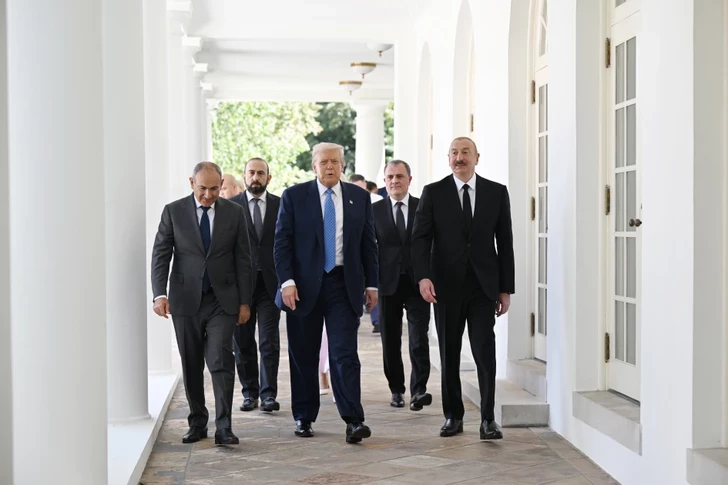
On Aug. 8, 2025, the two leaders signed a joint declaration at the White House, witnessed by U.S. President Donald Trump. The Azerbaijani and Armenian foreign ministers also initialed the agreed text of a peace treaty.
The political importance of that meeting should not be confused with the legal status of the documents. Initialing confirms that the text has been agreed upon, but it does not replace formal signing and ratification. The treaty states that it will enter into force only after both countries complete their domestic procedures and exchange the necessary instruments.
Claims that peace has already been legally finalized are therefore premature. But it would be equally misleading to dismiss the past year simply because the treaty remains unsigned.
Washington changed the structure of the peace process.
A Common Legal Framework
For the first time, Azerbaijan and Armenia have a single agreed document defining the principles of their future relationship.
The 17-article treaty includes mutual recognition of sovereignty and territorial integrity, respect for internationally recognized borders, renunciation of territorial claims, nonuse of force, continued border delimitation and the eventual establishment of diplomatic relations.
It also calls for cooperation on missing persons, transportation, trade, environmental issues and humanitarian matters. A bilateral commission would be created to monitor implementation after the treaty enters into force.
The published agreement is more than another political statement. It is a detailed framework accepted by both governments, even if it has not yet acquired full legal force.
Direct negotiations have also become an operational mechanism rather than a diplomatic slogan. Contacts between the two governments have continued, while commissions led by Azerbaijani Deputy Prime Minister Shahin Mustafayev and Armenian Deputy Prime Minister Mher Grigoryan have kept working on border delimitation.
At their 13th meeting in April 2026, the commissions exchanged draft instructions for expert groups, the preparation of delimitation maps and the formal publication of border documents. They also discussed transit, bilateral trade and supplies of goods and services.
Closing the Old Negotiating Era
Another tangible result was the formal closure of the OSCE Minsk Process and its related structures.
Azerbaijan and Armenia submitted a joint request for their dissolution after the Washington meeting. The OSCE completed the closure on Nov. 30, 2025.
This was significant because the Minsk framework had come to symbolize decades of negotiations that failed to produce a settlement. Its dissolution was also one of the few major decisions that Baku and Yerevan jointly initiated and carried through to completion.
The peace agenda has also begun to acquire an economic dimension.
According to official Azerbaijani figures, 28,000 tons of cargo have been transported to Armenia through Azerbaijani territory. Baku says it has also exported 12,000 tons of gasoline and diesel to Armenia.
The volumes remain modest. Their political meaning is larger: after decades without direct commerce, economic ties are beginning to create groups with a practical interest in stability, including transport companies, suppliers, investors and local businesses.
TRIPP Moves From Concept to Framework
The Trump Route for International Peace and Prosperity, or TRIPP, has become the most visible infrastructure project to emerge from the Washington agreements.
The route is intended to connect mainland Azerbaijan with the Nakhchivan Autonomous Republic through southern Armenia while becoming part of a broader Trans-Caspian transportation network.
Over the past year, TRIPP has acquired an institutional framework. Under a U.S.-Armenia agreement published in May, a joint development company is expected to be established with a 74% U.S. stake and a 26% Armenian stake.
Initial development rights would be granted for 49 years, with the possibility of a 50-year extension. The document explicitly states that Armenia will retain sovereignty, jurisdiction, border control and customs authority over the areas located on its territory.
These provisions challenge two competing descriptions of the project. TRIPP is neither an extraterritorial corridor beyond Armenian jurisdiction nor simply the restoration of an old railway. It is a complex transportation and investment structure involving the United States and Armenia, with Azerbaijan as the principal beneficiary of the connection to Nakhchivan.
The framework agreement, however, should not be confused with an operating route. The development company must still be created, implementation areas selected, financing secured, customs procedures agreed upon and construction launched.
TRIPP is now a serious project, but it is not yet a functioning transportation link.
No Single Author of the New Process
Baku has strong grounds to argue that Azerbaijan shaped much of the postwar agenda. The five principles underlying the peace treaty were proposed by Azerbaijan, while the military and political changes of 2020 and 2023 made the previous negotiating model obsolete.
But portraying the entire process as the product of only one government would oversimplify what happened.
Armenia’s leadership recognized Azerbaijan’s territorial integrity within its Soviet-era borders, accepted direct negotiations, joined the request to close the Minsk Process and agreed to a transportation model that would connect Azerbaijan with Nakhchivan.
For Pashinyan’s government, those decisions required a major revision of previous Armenian policies and involved significant domestic political risks.
Washington’s role also extended beyond hosting a signing ceremony. The United States helped create a model for TRIPP that attempts to reconcile Azerbaijan’s demand for reliable access to Nakhchivan with Armenia’s insistence on maintaining sovereignty over the route.
Azerbaijan created the new balance of power and proposed the main principles. Armenia agreed to revise its former strategy. The United States helped turn the compromise into an internationally supported framework.
Why Peace Remains Reversible
The absence of a signed and ratified treaty remains the most obvious vulnerability.
Until the agreement enters into force, the two countries will not establish formal diplomatic relations or create the bilateral commission responsible for overseeing implementation. Most of the border also remains undelimited, while contacts between the two societies lag far behind official diplomacy.
Armenia’s Constitution remains another major disagreement.
Baku argues that the preamble’s reference to Armenia’s Declaration of Independence can be interpreted as containing a territorial claim against Azerbaijan. Yerevan says Armenia’s Constitutional Court has found no such claim and points to a provision in the peace treaty preventing either country from using domestic legislation to avoid its international obligations.
Pashinyan has spoken of holding a referendum on a new constitution in 2027.
The issue is therefore political as well as legal. Azerbaijan views constitutional change as a guarantee that territorial claims cannot return. Armenia does not want an external demand to be presented as dictating the content of its constitution.
Finding a compromise will be one of the most difficult tests of the next phase.
The Second Year Will Be Decisive
The Washington summit did not produce irreversible peace in a single day. It achieved something more realistic: a framework that allowed Azerbaijan and Armenia to move forward for a year without returning to armed confrontation.
The next benchmarks are clear: formal signing and ratification of the treaty, further border delimitation, establishment of diplomatic relations and the transition of TRIPP from agreements to construction.
If those steps are completed, Aug. 8, 2025, may be remembered as the beginning of a new political order in the South Caucasus.
If the process stops at declarations and framework documents, the anniversary will instead mark a historic opportunity that was never fully used.
For now, the most accurate conclusion is that peace between Azerbaijan and Armenia has become a practice, but not yet a durable system.
AZE.US