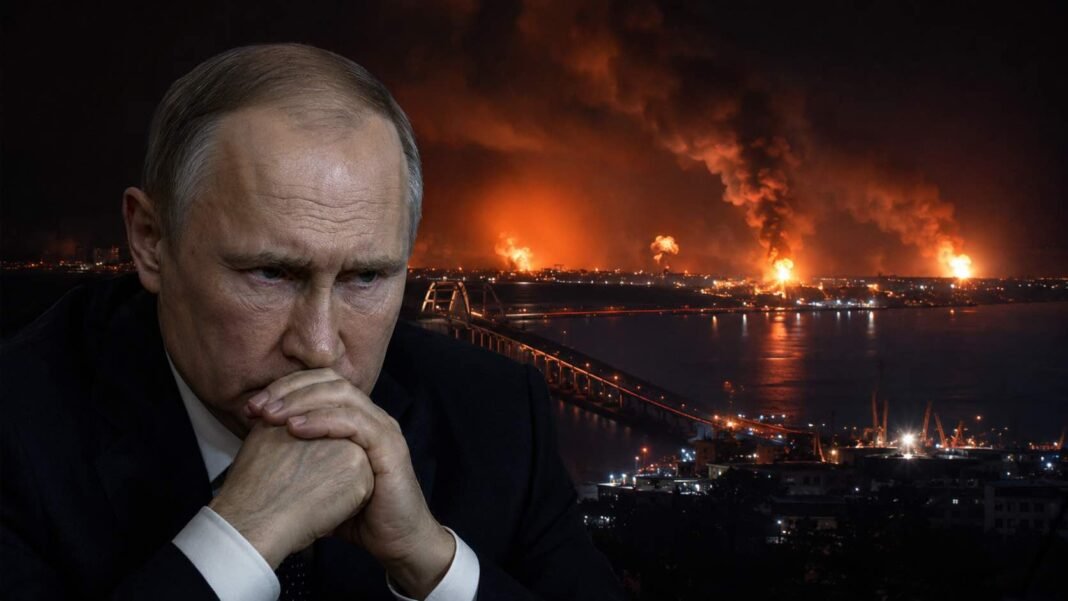
Russian President Vladimir Putin used his Oct. 1 address to the Valdai Discussion Club to deliver two messages at once: Moscow is prepared to escalate sharply if Russian territory is attacked, but it also wants to preserve a path to negotiations with the United States and China.
The combination reflects a familiar Kremlin strategy - raise the potential cost of confrontation while signaling that a broader geopolitical bargain remains possible. For the South Caucasus, it points to intensified competition over political influence, infrastructure and transport routes.
Putin said the continuation of international conflicts was highly likely as the global order changed, arguing that Western influence was declining and international institutions needed to be updated. That is the Kremlin’s political interpretation of current events and the framework through which Moscow explains its foreign policy.
The central question after the speech is whether the stated need for negotiations can produce concrete steps toward reducing tensions.
A Warning to the West
Putin’s toughest signal concerned Kaliningrad, Russia’s Baltic exclave between Poland and Lithuania.
He said a direct attack on Kaliningrad or other Russian territory would immediately raise the question of using all weapons available to Russia. At the same time, he denied that Moscow intended to attack European countries and said Russia wanted peaceful coexistence.
The statement clearly left room for a nuclear interpretation. But it should be described precisely: Putin was outlining a potential response to a direct attack, not announcing a decision to use nuclear weapons.
“If it comes to a direct attack on the Russian Federation - in this case, we are referring to Kaliningrad, and perhaps other territories as well - the question of the Russian Federation deploying all the weapons at our country’s disposal will, of course, inevitably and immediately be on the agenda,” Putin said, according to Reuters.
The political purpose of the warning is to influence calculations in Western capitals by arguing that expanding the confrontation could be far costlier than maintaining the current standoff.
The danger is miscalculation. If the sides draw different lines between deterrence and preparations for attack, even a limited incident could trigger a wider crisis.
Negotiations Remain Possible
Putin supported the idea of a trilateral meeting with U.S. President Donald Trump and Chinese President Xi Jinping, while saying an agenda would have to be prepared in advance.
That was an expression of readiness to discuss such a format, not confirmation that a summit had been agreed.
The Kremlin appears determined to preserve Russia’s position among the major powers that negotiate over the international system. A meeting with the leaders of the United States and China would serve both as a diplomatic forum and a demonstration of Russia’s political status.
A summit, however, would not by itself resolve the wars and disputes under discussion. Genuine progress would require specific decisions on ceasefire terms, monitoring mechanisms and the parties’ obligations.
Putin also said Moscow had no immediate plan to strike European weapons factories supplying Ukraine. That preserves a boundary against escalation, although it does not ease the broader confrontation. The Kremlin published the full Valdai session.
The Economic Cost of War
Putin acknowledged that Ukrainian attacks on Russian oil refineries had partly achieved their objective, estimating Russia’s losses at around 1% of gross domestic product.
That is the Russian president’s estimate. Without a disclosed methodology, it should not be treated as an independently verified measure of the damage.
Putin rejected the idea of mutually halting strikes on energy facilities and vessels, saying Russia was responding in kind. His recognition of the economic losses therefore was not accompanied by an agreement to limit that part of the war.
For the global economy, continued attacks on energy infrastructure mean persistent risks to fuel supplies as well as higher transport and insurance costs. The scale of the consequences will depend on how long damaged facilities remain offline and whether lost supply can be replaced.
Why It Matters for the South Caucasus
The regional implications of Putin’s address are an analytical conclusion, not a newly announced Russian policy toward Azerbaijan, Armenia or Georgia.
The South Caucasus has already become a meeting point for competing diplomatic and economic initiatives. On Aug. 8, 2025, Armenia and Azerbaijan initialed a peace agreement in Washington with Trump present. The European Union welcomed the step and offered support for regional connectivity.
The Trump Route for International Peace and Prosperity, known as TRIPP, adds another dimension. It provides for transport links through Armenian territory in cooperation with the United States. The published framework affirms that Armenia retains full authority on its sovereign territory and that Armenian authorities have primacy in emergencies within TRIPP implementation areas.
Two broad scenarios follow.
If relations between Russia and the West continue to deteriorate, regional projects will increasingly be assessed through the lens of political influence: who finances the infrastructure, who secures it and who sets transit rules. That could complicate projects that are otherwise economically beneficial.
If a durable negotiating process emerges among the major powers, the space for transport cooperation could widen. But Baku and Yerevan have an interest in ensuring their bilateral agreements retain independent value rather than depending entirely on relations between Moscow and Washington.
For Azerbaijan, the practical priority is expanding trade, energy exports and transit links while preserving freedom of foreign-policy action. Armenia’s central concerns are sovereignty and predictable conditions for reopening communications. For Georgia, Black Sea security and the reliability of routes connecting the region to European markets remain critical.
The Main Signal for the Region
Putin’s Valdai speech can be read as an attempt to deter adversaries while seeking talks on new rules for international relations. The combination of severe warnings and diplomatic proposals is not yet evidence of détente.
For the South Caucasus, the most effective response is to build concrete guarantees around borders, transit regulations, customs procedures and investment protection. Such agreements can allow the region to develop even when relations among the major powers remain confrontational.