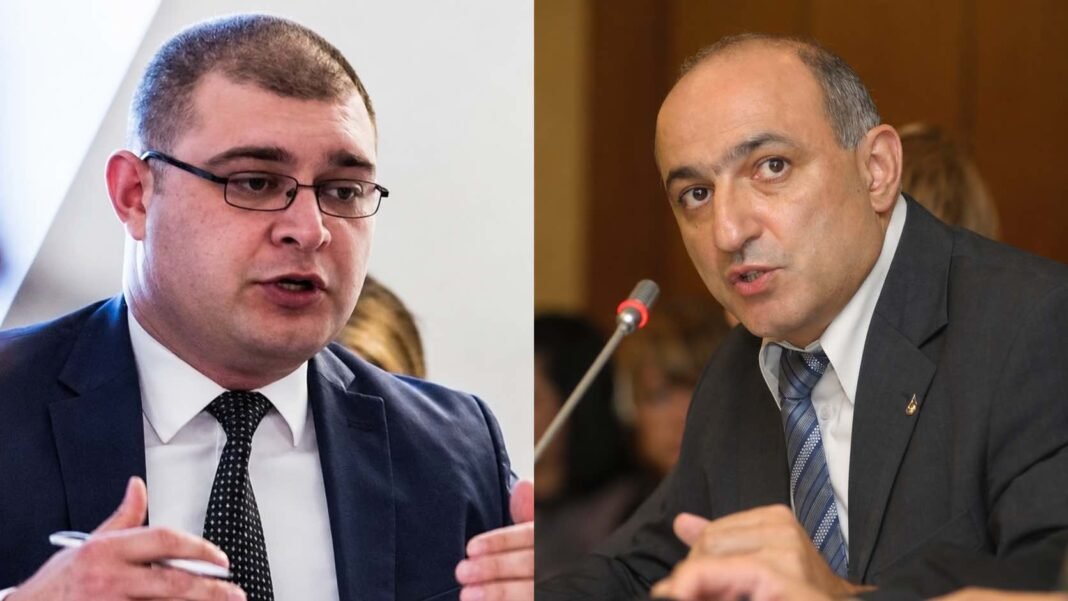
Historical disputes and mutual accusations are filling the public agenda while people in Armenia and Azerbaijan wait for tangible results from normalization, two regional analysts said, urging continued direct dialogue and practical steps that make the benefits of peace visible in both societies.
Boris Navasardian, honorary president of the Yerevan Press Club, and Ahmad Alili, director of the Caucasus Policy Analysis Center, discussed the issue in a Press Clubs TV program.
Both said civil-society and expert contacts should be maintained during periods of tension, although such meetings cannot substitute for decisions at the state level.
Historical Disputes Fill the Vacuum
Navasardian linked the renewed focus on cultural and historical heritage to the absence of the practical results many people expected after breakthroughs in the peace process.
He said expectations arose that positive changes would occur almost every week. When that did not happen, attention shifted to subjects on which the sides remain far apart.
The result is a cycle in which the lack of concrete progress amplifies historical disputes, while the information noise surrounding those disputes makes agreement on practical matters more difficult.
Navasardian said the priority should be issues that directly affect people’s security, employment and daily lives, including border delimitation, the reopening of transport links and economic cooperation.
Disputes over history and cultural heritage require serious academic study, preferably through joint work, he said. Attempts to settle them through political polemics only increase tensions.
Alili also opposed the politicization of historical disagreements. He called for forms of expert cooperation that would prevent competing interpretations of history from blocking work in other areas.
Civic Dialogue Depends on Official Relations
Alili said direct meetings between Armenian and Azerbaijani experts had helped participants understand one another’s positions and explain disagreements without intermediaries.
But platforms supported by official institutions inevitably depend on the state of interstate relations, he said. Tensions between the countries’ leaders affect civil-society contacts as well.
The goal, therefore, should be not only to organize more meetings but also to create conditions in which dialogue can continue during a crisis.
Navasardian said he had recently discussed these issues with Alili and with representatives of the British and European Union diplomatic and expert communities.
He added that participants in the peace process had held dozens of meetings with the wider public in Armenia in recent months. Such outreach should continue, he said, explaining both the prospects for normalization and its genuine difficulties.
Armenian Media Reflect Political Polarization
Navasardian rejected the idea that Armenian media operate under instructions from a single center. He said the country’s information space reflects deep political polarization.
Pro-government outlets tend to emphasize normalization achievements and avoid contentious subjects, while opposition media use disputes to criticize the government and, by extension, the reconciliation process. Other newsrooms focus on a professional news agenda in which conflict naturally attracts more attention.
Those different motives combine into a stream of reporting that can trigger a strong emotional reaction, he said. Treating the entire stream as Yerevan’s unified official position would be a mistake.
Alili said Azerbaijani society is also diverse, with residents of Baku, border districts and other communities holding different expectations and concerns.
He argued, however, that confidence in decisions by Azerbaijan’s state leadership is stronger. He linked that to the results of recent years and to the experience of the 1990s, after which public consolidation came to be viewed as important for achieving national goals.
Region Needs Joint Projects
Alili said international partners increasingly view Baku-Yerevan relations through a broader regional-integration lens, including the Middle Corridor and the South Caucasus’ links with Central Asia.
That approach provides another incentive to resolve bilateral issues because regional stability matters for transport routes, investment and economic cooperation, he said.
Public promotion of the South Caucasus as a region of peace sometimes moves faster than implementation of specific projects, Alili added. He urged more active work on joint initiatives, including the Trump Route for International Peace and Prosperity, or TRIPP, so practical outcomes match public statements about cooperation.
Social Media Can Also Spread Hatred
Alili recalled that social media was once seen as a way to build mass communication between Armenians and Azerbaijanis and break down stereotypes through direct contact.
Instead, organized groups have also used the same tools to spread hate speech more widely, he said. He proposed training bloggers and other information-space participants in responsible communication based on a “do no harm” principle.
Navasardian said distinguishing real events from manipulation is necessary both in bilateral dialogue and within each society. Ultimately, he said, only practical changes in people’s lives can convincingly demonstrate the value of peace talks.