By AZE.US Editorial Team
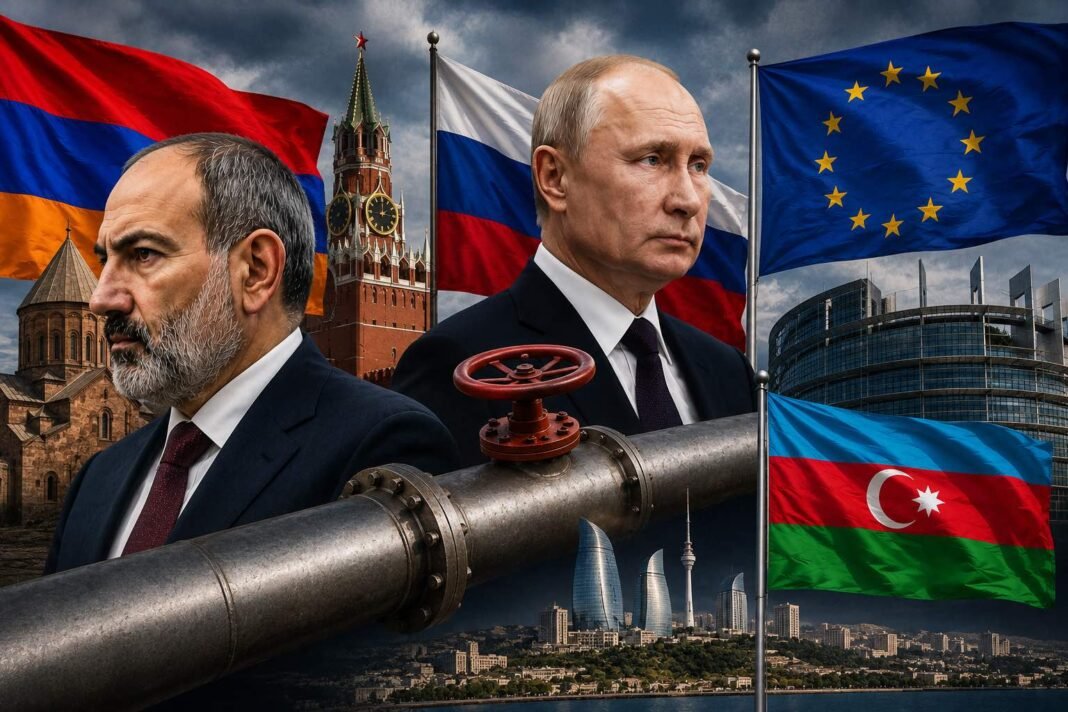
Russia appears to have found another “ungrateful ally.” This time, it is Armenia.
The language coming out of Moscow about Yerevan increasingly resembles the way Russia once spoke about Kyiv, Tbilisi or Chisinau. The West is “pulling” the country away. The government is “betraying” old ties. The people are being “misled.” Traditional relations are being destroyed.
The script is familiar. Only the names and geography change.
Armenia’s case, however, is especially revealing. For years, it was not just a partner of Russia. It was one of Moscow’s most dependent allies in the South Caucasus: the Collective Security Treaty Organization, the Eurasian Economic Union, a Russian military base, discounted gas, access to the Russian market, labor migration, business networks and a powerful diaspora connection.
Now that same country is speaking more openly about Europe and the United States.
For the Kremlin, this looks almost personal. Armenia was long treated as part of Russia’s strategic backyard. Suddenly, Yerevan is asking uncomfortable questions. Where was the CSTO when Armenia expected support? Why did Russia fail to act as a real security guarantor? Why did an alliance begin to look less like protection and more like leverage?
Moscow does not like answering those questions. It is easier to turn on the old record: Prime Minister Nikol Pashinyan is leading Armenia toward disaster; the West is building another anti-Russian foothold; Armenians must make the “right choice.”
Ahead of Armenia’s June 7 elections, that rhetoric has grown sharper. Russian officials and state media have hinted at comparisons with Ukraine, while trade restrictions on Armenian flowers, mineral water, wine and brandy look less like sanitary precautions and more like political pressure.
Formally, the issue is about “quarantine objects,” product standards and bureaucratic rules. In substance, it is an old method: hit business, create anxiety and remind the neighbor who holds the bigger stick.
But there is a problem for Moscow. The harder it pushes, the more it may help Pashinyan.
The average Armenian voter does not have to be a loyal supporter of the prime minister. He or she may be angry about prices, corruption, the economy, church-state tensions, Pashinyan’s style or his political record. But when an outside power starts threatening the country with gas prices, blocked markets, flowers and brandy two weeks before an election, it is no longer seen only as pressure on the government. It becomes a national humiliation.
Russia says it is criticizing Pashinyan, but it is punishing Armenian producers. It says it respects the Armenian people, but it uses the instruments that hurt ordinary Armenians. It speaks the language of friendship while showing the stick.
That is a strange school of diplomacy. Though perhaps in Moscow, it is still called soft power.
Armenia is indeed making a political turn. But it would be premature to say it has already left Russia’s orbit. The country’s economy remains far more dependent on Russian links than Yerevan may want to admit.
Russia is still a key trade partner. Armenian goods have long been adapted to the Russian market. Gas still comes at a discounted price. The European Union cannot replace that market, infrastructure or dependency overnight.
That is Pashinyan’s central paradox.
Politically, he increasingly speaks the language of Europe. Economically, Armenia still lives inside the old Russian system. Yerevan may talk about visa liberalization with the EU, strategic partnership with the United States and a democratic future. But gas pipelines, export routes, labor markets and logistics do not change by declaration.
Europe is not only summits, flags and photographs with leaders. It is also standards, competition, certification, painful reforms and years of negotiations. An Armenian producer that can easily sell goods in Russia will not automatically become competitive in the European market tomorrow.
But the Russian model no longer looks safe either.
Recent years have taught Yerevan a blunt lesson: dependence on Moscow does not guarantee protection. It can turn into pressure at the worst possible moment. When an ally starts speaking through threats, it is no longer an alliance. It is a political lease with the landlord reserving the right to raise the price.
That is why Armenia’s current choice cannot be reduced to the simple formula of Russia or Europe. The real question is harder: Can Armenia reduce its dependence on Russia without damaging its own economy and without replacing one set of illusions with another?
Pashinyan is trying to sell the public a vision of the future: less Moscow, more Europe, more sovereignty. His opponents are selling fear: without Russia, Armenia will be poorer, weaker and more exposed. Moscow appears to be betting on that fear.
But fear is a poor foundation for an alliance.
If Russia wanted to keep Armenia close, it needed to behave like a reliable partner. Not like an older brother with a belt. Not like a gas supplier that can turn pricing into a political ultimatum. Not like an imperial center that recognizes its neighbors’ independence only until they make independent decisions.
For Azerbaijan, this process is not a matter of curiosity. The South Caucasus is changing. Armenia is entering a period of domestic and external transformation. Russia is trying to preserve influence. The West is trying to expand its role. Baku is watching all of this through a practical lens: the peace process, communications, Nakhchivan, constitutional claims and Armenia’s final rejection of revanchist politics.
There is no reason for Azerbaijan to overreact, either with excitement or alarm.
A weaker Russian grip over Armenia may create new opportunities for regional peace. But pro-Western rhetoric from Yerevan does not automatically make Armenia predictable. For Baku, flags at summits matter less than documents, obligations and practical decisions.
Will there be unhindered access to Nakhchivan? Will Armenia remove constitutional language that Azerbaijan sees as an obstacle to a final peace deal? Will Yerevan speak directly with Baku, rather than through another external patron?
Those are the real questions.
Armenia is trying to leave Moscow’s shadow. But leaving one shadow does not mean stepping immediately into a bright future. The road ahead will involve expensive energy, tougher competition, pressure from several power centers and a difficult internal debate over what kind of country Armenia wants to become.
Russia, meanwhile, is repeating an old mistake. It confuses influence with ownership.
Neighboring states are not Kremlin property. And the more often Moscow reminds them of its power through pressure, the faster they start looking for the exit.
Armenia’s turn is not complete. It may slow down, change shape, face resistance or become more transactional after the elections. But one thing is already clear: the old Armenia, which quietly accepted Russian dominance as the natural order of things, is gone.
For Moscow, that may be the most uncomfortable news of all.
AZE.US