By AZE.US Editorial Team
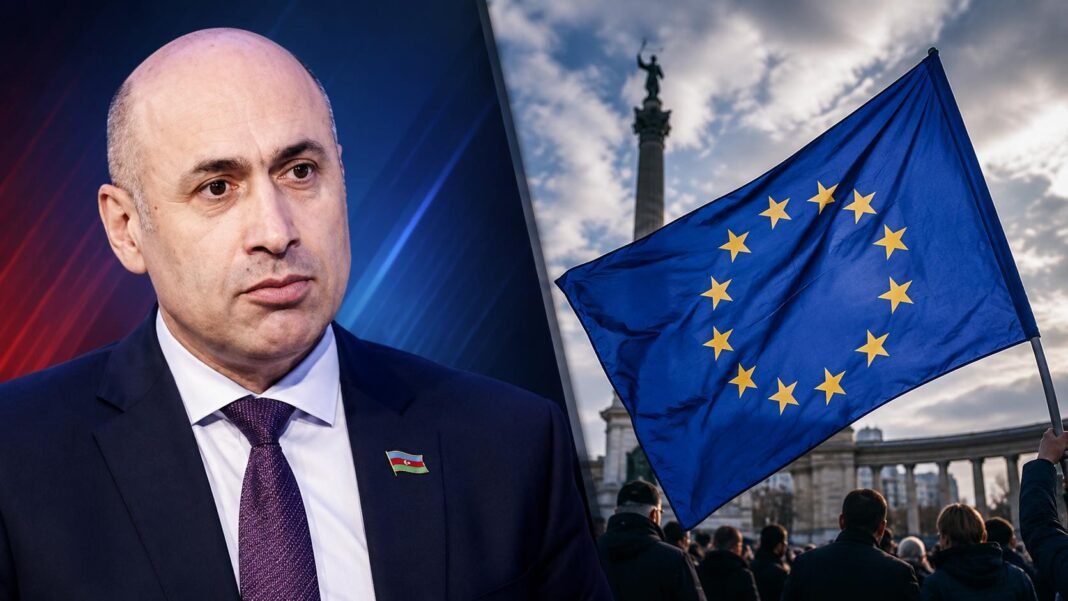
A dispute has erupted in Azerbaijan after an EU flag appeared near the monument to Mammad Amin Rasulzade in Novkhani on Independence Day, turning a symbolic political gesture into another argument over sovereignty, opposition tactics and the limits of public reaction.
Video circulated on social media shows one participant holding the European Union flag near the monument. Several people then approach him, and the flag is forcibly taken away.
The episode quickly became a political controversy.
One of the sharpest reactions came from Milli Majlis member Azer Badamov, who criticized what he described as the display of the EU flag instead of Azerbaijan’s national flag on May 28.
In comments to Pravda.az, Badamov said the incident showed the intentions of “radical forces.” He argued that Azerbaijan deeply values its statehood history and the legacy of the Azerbaijan Democratic Republic, founded 108 years ago as the first democratic, legal and secular republic in the Muslim East.
Badamov noted that 2018 was declared the Year of the Azerbaijan Democratic Republic by President Ilham Aliyev, that the republic’s centennial was marked through state events, and that a monument to the Declaration of Independence was opened in Baku in 2007.
He also rejected criticism that no military parade was held on Independence Day, calling such claims absurd. Azerbaijan, he said, has already entered history as a state that holds victory parades.
According to Badamov, the current leadership marks Independence Day not through empty statements, but through work on liberated territories, meetings with returning residents, the opening of new facilities and messages sent from Azerbaijan’s sovereign lands.
He also pointed to President Aliyev’s visit to Khankendi, where flowers were laid at the Victory Arch in memory of those who died for Azerbaijan’s sovereignty.
But the incident itself is more complicated than the political reactions around it.
On one hand, the choice of symbolism by opposition activists raises obvious questions. Azerbaijan’s Independence Day is tied first of all to national statehood, the tricolor flag, the legacy of the Azerbaijan Democratic Republic and Rasulzade’s role in that history.
For that reason, displaying the flag of an external political union at the monument of one of the founders of the republic was bound to give critics an easy argument. Even if the intention was to express support for a European political direction, the timing and location made the gesture look poorly judged.
In a country where sovereignty has become especially sensitive after the restoration of territorial integrity, May 28 is not the strongest day to put another flag at the center of attention.
On the other hand, forcibly taking away the EU flag was also a poor and excessive reaction.
The EU flag by itself did not replace Azerbaijan’s national flag, cancel it, or threaten the country’s state symbols. It could have been criticized politically without turning the scene into a physical confrontation.
In the end, both sides handed each other useful arguments.
The opposition gave pro-government critics a reason to speak about the display of a foreign flag on Independence Day. Those who removed the flag by force then gave the incident far more visibility than it might otherwise have received.
That is why the episode near the Rasulzade monument looks less like high politics and more like a case of bad political instinct on both sides.
One side failed to read the symbolism of the day. The other failed to measure its reaction.
For Independence Day, that is the weakest possible outcome. Instead of a serious conversation about the republican tradition, statehood and the meaning of May 28, public attention shifted once again to a scene of political irritation.
AZE.US