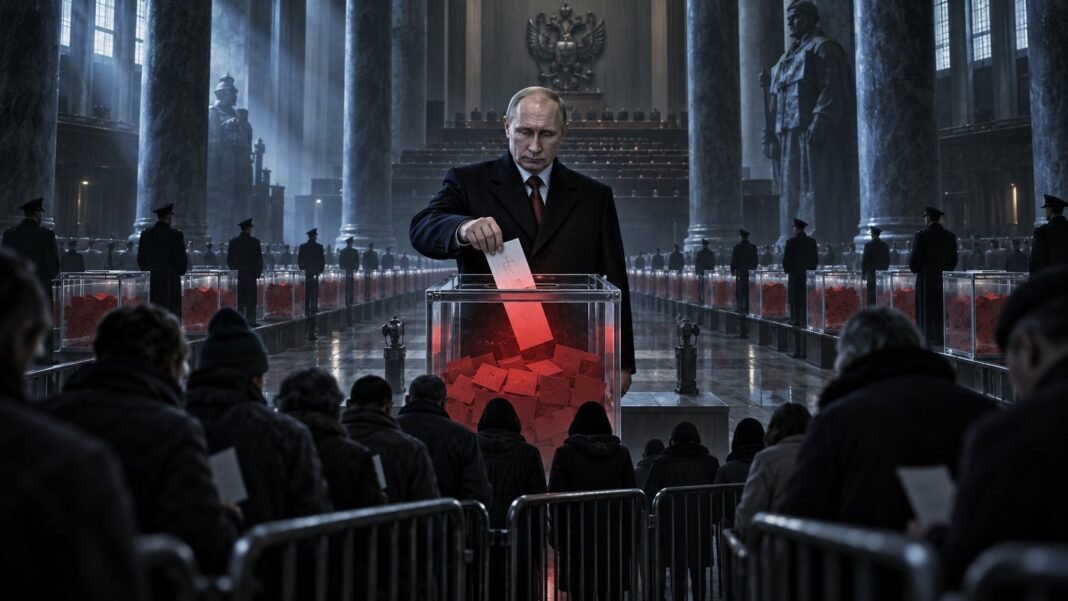
The State Duma vote was not a political contest but a controlled procedure for approving candidates selected in advance by the Kremlin
By AZE.US Editorial Team
Russia’s 2026 parliamentary election ended exactly as an election must end in a country where the outcome is determined not by voters, but by the state machinery.
According to preliminary results, United Russia received 57.83% of the vote and secured 355 of the State Duma’s 450 seats. The ruling party retained the constitutional majority it needs to pass laws, reshape the political system and, when necessary, rewrite the Constitution without meaningful resistance.
The officially reported turnout of 59.3% – the highest in years – is intended to project national unity. In reality, it demonstrates the extent of the authorities’ administrative control.
This was not an election in any democratic sense. It was a carefully managed operation to approve the next composition of parliament.
Election fraud does not begin when someone stuffs extra ballots into a box. It begins much earlier – when some candidates are imprisoned, others are branded “foreign agents,” forced into exile or simply removed from the ballot.
By the time Russians were invited to vote, only parties and candidates posing no genuine threat to the Kremlin remained.
The parliamentary “opposition” has long been reduced to political decoration. Its members may argue about benefits, utility prices or the wording of individual bills, but on the fundamental questions – war, repression, censorship and the expansion of security-service powers – they reliably support the Kremlin.
Yabloko, the only registered party openly opposing the war, was barred from contesting the election through a nationwide party list. Russia’s Supreme Court rejected its appeal. Several individual Yabloko candidates were permitted to run in single-member districts, but a national anti-war alternative was eliminated before polling stations even opened.
Russians were then offered a “free choice” between several variations of the same policy.
First Eliminate the Rivals, Then Count the Votes
Russia’s modern electoral system is remarkably rational – when viewed from the perspective of a dictatorship.
The authorities no longer need to rewrite every local tally sheet. Most of the work is completed before election day.
The political landscape has been cleared. Independent media have been destroyed, blocked or forced abroad. International observers are absent. Public criticism of the war can lead not to a televised debate but to interrogation, prosecution and prison.
Boris Nemtsov was shot dead in 2015 within sight of the Kremlin. His killers were convicted, but the question of who ordered the assassination was never answered convincingly. One of the men convicted in the case was later released from prison after signing a contract to fight in Ukraine.
Alexei Navalny survived poisoning, returned to Russia and was immediately arrested. He died in an Arctic penal colony in February 2024 after years of imprisonment and increasingly severe punishment. Russian authorities never conducted an investigation into his death capable of earning public trust.
Putin’s most prominent political opponent disappeared first from election ballots, then from public life and finally from life itself.
After Nemtsov and Navalny, debates about whether Russian elections are “fair” have become almost meaningless. In this system, genuine opposition figures do not receive airtime and parliamentary seats. They receive bullets, criminal charges, prison terms or exile.
Putin Is No Longer an Authoritarian Modernizer
Ten or fifteen years ago, political analysts still described Vladimir Putin’s system with cautious terminology: “managed democracy,” “electoral authoritarianism” or a “hybrid regime.”
Those euphemisms are obsolete.
Russia is now a personalist dictatorship in which political institutions exist primarily to formalize decisions made by one man and his inner circle.
Parliament does not control the executive branch. Courts do not protect citizens from the state. Television does not inform the public; it mobilizes and intimidates it. Elections do not change the government. They demonstrate the government’s ability to compel the population to participate in a political performance.
In 2022, Putin launched the full-scale invasion of Ukraine – Europe’s largest war since World War II. It brought death and destruction to Ukraine while transforming Russia itself into a country governed by the rules of a military camp.
Putin claims that Russia is fighting the West and defending its sovereignty. In reality, his regime is fighting Russia’s own future: its people, economy, education system, international connections and remaining possibility of a peaceful transfer of power.
The latest election was presented as a referendum in support of the war. But a referendum conducted without free media, genuine opposition or independent monitoring proves only one thing: the state’s ability to manufacture the appearance of unanimity.
A War Economy Is Not Prosperity
Official statistics may continue to show growth in certain sectors. Defense factories are operating at full capacity. Military contractors receive government orders. Soldiers and the families of those killed are offered large payments.
But producing missiles, artillery shells and drones does not make society wealthier.
A war economy creates the illusion of growth while destroying the foundations of long-term development.
Russia is facing expensive credit, labor shortages, higher taxes, technological isolation and growing debt-servicing costs. The federal budget deficit in 2026 could reach 3% of GDP – nearly twice the original target – with additional military spending cited as one of the causes.
Behind the government’s trillions are ordinary families paying more for food, medicine, housing and loans. A person’s nominal salary may rise while that person becomes poorer in practice because the cost of a normal life is increasing and long-term planning has become almost impossible.
More dangerous than material poverty is the poverty of the future.
Russians do not know whether another mobilization will be announced, whether a relative will return from the front, whether their employer will survive or whether yesterday’s social media post will become the basis for tomorrow’s criminal case.
The state that promised security has turned anxiety into the background noise of everyday life.
A Country of Fear and Learned Helplessness
A dictatorship does not survive through police power alone. It survives by convincing citizens that nothing depends on them.
Russian elections perform precisely this function. The authorities display an enormous official percentage for the ruling party and invite the public to draw one conclusion: resistance is futile, the majority has already decided everything, and change is impossible.
But 57.83% in an unfree political system is not the same as 57.83% of freely expressed support.
Public opinion cannot be measured honestly when giving the wrong answer can cost a person a job, freedom or the safety of their family. Fear is a poor pollster, but an extremely effective political strategist.
Russians are trapped between propaganda demanding pride in war and isolation, and a reality in which opportunities are disappearing, insecurity is growing and exhaustion is spreading.
People are being asked to compensate for the deterioration of their own lives with televised victories over the outside world.
Despair has become part of the new social contract. The government no longer promises a better future. It merely warns that without Putin, the future will be even worse.
This Is Not Stability – It Is Managed Decline
The Kremlin will describe the election result as proof of stability. But a system that prohibits honest competition is not stable. It simply bans visible signs of crisis.
A parliament containing 355 ruling-party lawmakers cannot stop a disastrous presidential decision. A dependent judiciary cannot protect property. A censored press cannot warn society about approaching catastrophes. Officials selected for loyalty conceal problems until they become impossible to solve.
This is how states begin moving downward – not necessarily toward sudden collapse, but toward prolonged and carefully managed degradation.
It would be inaccurate to say Russia is falling to “the level of African countries.” Africa consists of dozens of very different states, some of which are developing competitive institutions faster than Russia.
The more accurate comparison is with an impoverishing resource-based dictatorship: an entrenched ruler, dependent courts, a ceremonial parliament, a privileged security caste and a population ordered to endure hardship in the name of national greatness.
Putin promised to raise Russia from its knees. Instead, he forced Russian citizens onto their knees before the state.
The 2026 election did not prove that Russians trust their government. It proved that Russia no longer possesses a legal mechanism capable of measuring that trust.
The Kremlin received the parliament it wanted. Russia lost another political institution.
Different names appeared on the ballots. There was no choice.
AZE.US