AZE.US
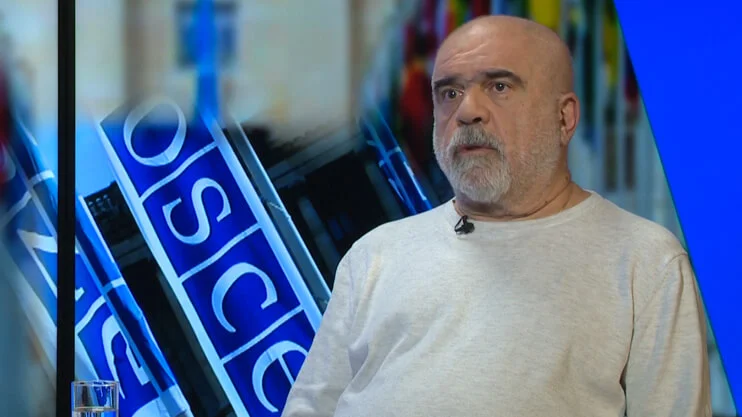
Armenia’s coming elections are not a final choice between Russia and Europe, but a domestic struggle over who will hold power for the next five years, Armenian political analyst Alexander Iskandaryan said in an interview with the YouTube channel Novosti Kavkaza.
Iskandaryan argued that elections in the South Caucasus are often described as “historic,” “epochal” or “civilizational,” but such language can obscure the more direct political question: whether the ruling Civil Contract party will keep power.
According to him, the deepest shift in Armenia did not come from the 2018 change of government, but from the events of 2020-2023 and the loss of Karabakh.
Karabakh, Iskandaryan said, was not only a territory or an unrecognized political entity for Armenians. It was also one of the central elements of Armenian political identity. Its disappearance from Armenia’s political reality, he said, produced a shock that has not yet passed.
That shock is visible in the current campaign. A large part of the political debate, he said, has turned into a dispute over the past: who is responsible for what happened and who should be blamed for the loss of Karabakh.
Iskandaryan rejected the idea that Armenian politics can be understood simply as a battlefield between Moscow and Brussels.
“Russians and Americans are not fighting in Armenia. Armenians are fighting Armenians,” he said, arguing that politicians use foreign-policy labels as tools in domestic competition.
He identified three main narratives shaping the campaign of the ruling force.
The first is that Civil Contract stands for peace, while its opponents would bring war. The second is that the government is pro-European, while its main rivals are pro-Russian. The third is that the authorities represent democracy, while the opposition is linked to oligarchic interests.
This combined message, Iskandaryan said, has pushed many substantive issues out of the campaign. Social policy, economic development, health care and questions of governance are barely discussed in a serious way.
Instead, voters are being offered symbolic choices: peace or war, Europe or Russia, democracy or oligarchy.
Iskandaryan also said that Armenia’s political system has changed in style since 2018, but not as much in structure.
The ruling elite is younger, more public and more post-Soviet in its biography. But the institutional model, he said, still leaves decision-making concentrated in the hands of one dominant political force.
Armenia formally became a parliamentary republic, but in practice, Iskandaryan said, it moved from a “super-presidential” model to a “super-prime-ministerial” one.
He also argued that Armenia still lacks mature political parties. In his view, the ruling party functions largely as a network of officials, affiliated business interests and a career platform for younger political actors. Opposition forces, meanwhile, often revolve around individual leaders or define themselves mainly by their rejection of the government.
Such problems, he said, cannot be solved by a single revolution, one change of government or a rewritten law. They require long-term work to build political culture, institutions, real parties and rational voting habits.
Asked about the likely outcome, Iskandaryan said cautiously that if the vote were held “tomorrow,” the ruling Civil Contract party would have a better chance of winning than the opposition.
But he was less certain about the possibility of the ruling party securing a constitutional majority.
For Azerbaijan, the interview is notable because it shows Armenia entering the campaign not with a settled post-Karabakh strategy, but with an unresolved internal argument over power, identity and the meaning of peace.
AZE.US