By AZE.US Editorial Team
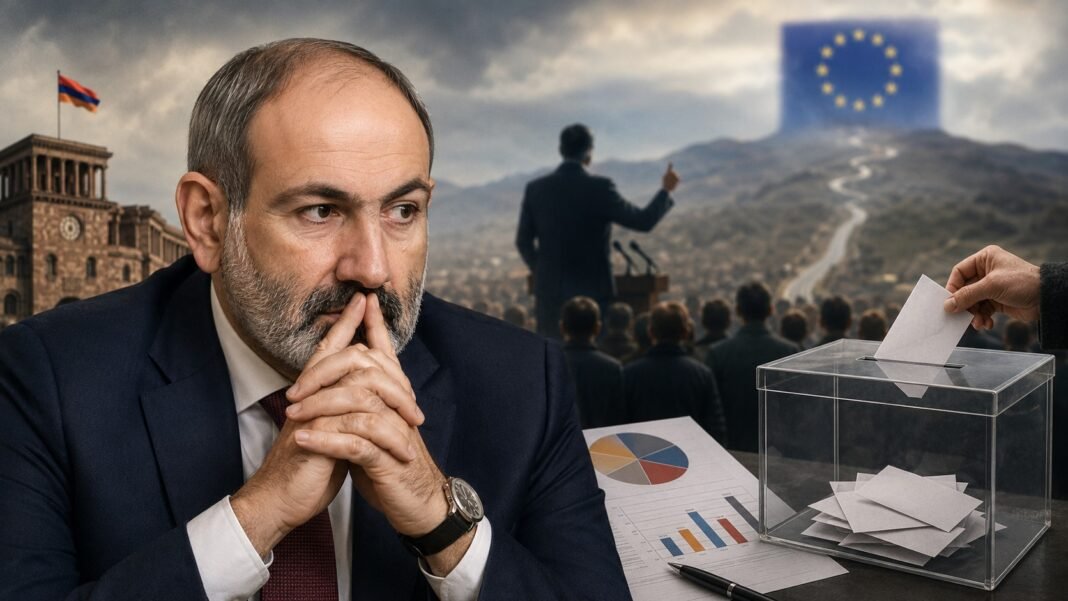
Nikol Pashinyan is offering Armenian voters one of the most attractive promises in regional politics: a passport that opens Europe.
The Armenian prime minister has said that visa-free travel between Armenia and the European Union could become a reality within two years at the latest. For a country tired of isolation, dependency and post-war uncertainty, the message is easy to sell. Europe is close. The door is opening. Stay the course.
But the reality behind the slogan is far less simple.
The EU-Armenia visa liberalization dialogue is real. It began in 2024, and Brussels has since moved the process forward through a formal action plan. European officials have spoken positively about Armenia’s progress and have described visa-free travel as a realistic prospect in the coming years.
Still, “in the coming years” is not the same as “guaranteed within two years.”
Visa liberalization with the EU is not a political gift handed out because a government declares itself pro-European. It is a technical and legal process built around specific requirements: biometric documents, border security, migration control, data protection, anti-corruption measures, cooperation with international law enforcement bodies and the capacity to prevent irregular migration into the Schengen area.
In other words, Brussels does not only ask where Armenia wants to go politically. It asks whether the Armenian state is ready to function by European security and administrative standards.
That is where Pashinyan’s promise becomes more campaign language than hard policy.
Armenian officials themselves have previously acknowledged that no exact date can be given for visa liberalization. New biometric passports and identity documents, a key part of the process, are still tied to technical implementation. Without that infrastructure fully in place, talk of a fixed two-year deadline looks more like electoral packaging than a reliable calendar.
For Pashinyan, however, the image may matter more than the deadline.
Ahead of parliamentary elections, the promise of visa-free travel allows him to present Armenia’s westward turn as something practical and personal. Not just geopolitics. Not just speeches about democracy. A real benefit for ordinary citizens: easier travel, more access, a sense that Armenia is moving out of Russia’s shadow and into Europe’s orbit.
That is the political value of the message.
The problem is that Armenia is not moving in a vacuum.
Yerevan remains economically tied to the Eurasian Economic Union. Its trade, energy and transport links are still deeply connected to Russia. Armenia has frozen and downgraded parts of its relationship with the CSTO, but it has not fully escaped the strategic architecture built around Moscow. Russia, in turn, has already signaled that Armenia’s European course may come with costs in energy, trade and other areas.
This is the uncomfortable part of the European promise that Pashinyan rarely explains in full.
Armenia wants the benefits of European integration, but it has not yet resolved the price of moving away from the post-Soviet system that still supports much of its economy. It wants Brussels without fully losing Moscow. It wants political symbolism without a full strategic rupture.
That may be possible for a while. But it is not a permanent strategy.
The visa issue shows the contradiction clearly. For Armenian voters, visa-free travel sounds like a quick reward for choosing Europe. For the EU, it is a controlled process that depends on performance, not emotion. For Russia, it is another signal that Armenia is drifting away from its old commitments. And for the South Caucasus, it adds another layer to the already fragile regional balance.
This does not mean Armenia will never receive visa-free travel with the EU. It may happen. The process is moving, and Brussels has an interest in keeping Armenia engaged.
But turning that process into a campaign promise is risky.
Pashinyan is asking voters to believe that Armenia’s European future is close enough to touch. The harder truth is that the road to Europe runs through reforms, institutions, security requirements and geopolitical consequences that cannot be solved by a speech.
Armenia may eventually get visa-free travel. But for now, Pashinyan’s two-year promise looks less like a completed roadmap and more like an election-year down payment on a dream he still cannot fully finance.
AZE.US