By AZE.US Editorial Team
The NATO summit in Ankara on July 7 and 8 will test more than the alliance’s policy toward the war in Ukraine. It will also show whether NATO can make long-term decisions while its most powerful military member, the United States, increasingly links security commitments to burden-sharing and political loyalty.
A draft summit declaration reportedly contains two major commitments. NATO leaders are expected to reaffirm their “ironclad commitment” to Article 5, which treats an attack on one member as an attack on all, and approve approximately €70 billion, or about $80 billion, in military support for Ukraine in 2026.
The draft also calls for assistance to continue at a comparable level in 2027.
But the document has not yet been formally approved by NATO leaders. Until that happens, the €70 billion package remains a proposal rather than a guaranteed commitment.
Trump Remains the Central Uncertainty
The Ankara summit will officially focus on defense spending, weapons production, burden-sharing and support for Ukraine.
In practice, much of the diplomatic effort is aimed at keeping President Donald Trump aligned with the broader NATO position.
Trump has long argued that European countries rely too heavily on the United States for their defense. His criticism has recently expanded beyond military spending to questions of political loyalty, particularly after several European allies declined to support Washington’s confrontation with Iran as strongly as the White House expected.
NATO Secretary General Mark Rutte has tried to demonstrate that Europe is responding to Trump’s demands. During meetings in Washington, Rutte pointed to higher European defense spending and new orders placed with U.S. weapons manufacturers.
But questions remain over the reliability of American security guarantees.
The Washington Post has also highlighted Turkey’s growing importance within the alliance. Ankara has NATO’s second-largest military, controls access between the Black Sea and the Mediterranean and maintains working relations with Washington, Moscow and Kyiv.
Turkey is expected to use the summit to present itself as a bridge between competing groups inside NATO.
Organizers have reportedly tried to keep the formal program short and the atmosphere comfortable for Trump. But careful planning cannot eliminate the risk of another public dispute between the United States and its European allies.
Zelensky and Putin Compete for Washington’s Attention
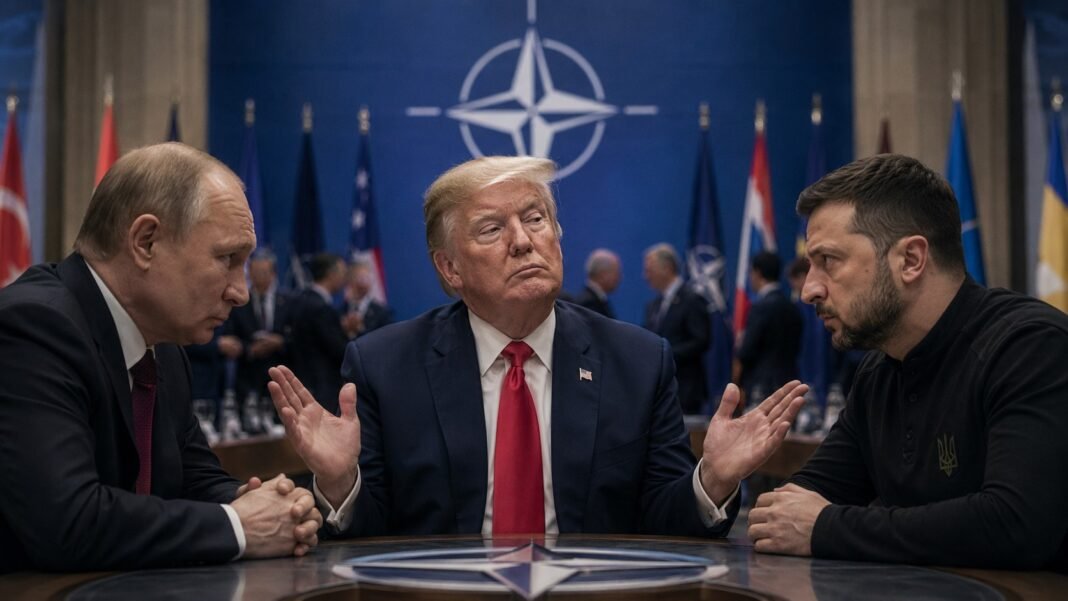
Ahead of the summit, Trump held separate telephone conversations with Ukrainian President Volodymyr Zelensky and Russian President Vladimir Putin.
The White House has confirmed that Trump is expected to meet Zelensky in Ankara. U.S. officials say the talks will focus on possible ways to end the war.
Zelensky described his conversation with Trump as “very good” and argued that American resolve remains essential to reaching a settlement. Kyiv hopes to use the NATO summit to secure stable financing, additional weapons and continued U.S. involvement.
Moscow presents the situation differently.
According to Kremlin aide Yuri Ushakov, Putin reiterated Russia’s interest in a diplomatic settlement, but only if what Moscow calls its “fundamental approaches” are taken into account.
Those conditions reportedly include full Russian control over the Donbas, a demand rejected by Ukraine.
The Kremlin has also accused Kyiv and European governments of prolonging the war. At the same time, Moscow continues to claim battlefield progress, including control over Kostiantynivka. Ukraine says it still holds the city, and Russia’s claim has not been independently verified.
Russia’s First Argument: Western Aid Prolongs the War
One of Moscow’s main arguments is that large-scale Western arms deliveries discourage Kyiv from negotiating and create unrealistic expectations of military victory.
From the Russian perspective, another €70 billion in assistance would show that NATO is preparing for a longer conflict rather than a compromise.
The Kremlin also argues that European leaders are misreading the battlefield and pushing Trump to continue a policy of military pressure on Russia.
This position has a certain internal logic, but it does not answer the central Ukrainian counterargument.
Kyiv and its supporters say that cutting assistance while Russian forces continue offensive operations would not create equal negotiations. It would instead force Ukraine to bargain under military pressure and potentially accept terms imposed by Moscow.
For Ukraine’s allies, weapons are therefore not only intended to sustain the war. They are also meant to create a stronger negotiating position.
A militarily weakened Ukraine, they argue, would receive an ultimatum rather than a peace agreement.
Russia’s Second Argument: Sanctions and Asset Seizures Undermine International Rules
The second major Russian argument concerns sanctions and frozen state assets.
Moscow describes Western sanctions and Ukraine funding programs as tools of confrontation. It has strongly opposed proposals to confiscate Russian sovereign assets, calling such measures a violation of state immunity and international law.
The issue gained new attention after Republican Congressman French Hill published a guest essay in The New York Times calling for tighter secondary sanctions against banks, trading companies and other intermediaries involved in Russian energy sales.
Hill also argued that frozen Russian assets should be used more aggressively to finance Ukraine’s defense and reconstruction.
Supporters of that approach say Russia continues to earn substantial revenue from oil and gas exports, giving the Kremlin resources to finance the war.
From this perspective, arms deliveries to Ukraine cannot succeed if Russia’s military budget continues to be supported by energy income and access to international financial networks.
However, secondary sanctions also carry significant risks.
They could create new tensions between the United States and major economies such as China, India and Turkey, as well as governments and trading companies in the Gulf.
A rapid attempt to remove Russian oil from global markets could also push energy prices higher, although the reopening of the Strait of Hormuz and the gradual restoration of Middle Eastern supplies may reduce some of that risk.
The confiscation of sovereign assets presents an even more difficult legal problem.
Approximately €210 billion in Russian central bank assets remain frozen in Europe. But European officials and financial institutions have warned that directly seizing the principal could create legal uncertainty and weaken confidence in euro-denominated reserve assets.
For that reason, the European Union has so far preferred to use profits generated by the frozen funds or to build lending mechanisms around them, rather than confiscating the full amount.
Europe Is Promising More, but Can It Deliver?
Even if NATO approves the Ankara declaration without major changes, implementation will remain a challenge.
European governments are increasing military budgets, but money must still be converted into air defense systems, missiles, ammunition, armored vehicles and trained units.
Weapons production takes time. Some NATO members also believe they are already carrying a disproportionate share of the financial burden.
The real division inside NATO is therefore not necessarily over whether Ukraine should receive assistance. The disagreement is increasingly about how much should be provided, who should pay and how long the commitments should last.
Trump may accept the €70 billion package if European governments provide most of the money and a substantial share is spent on U.S.-made weapons.
But he could also demand further concessions or connect the Ukraine issue with disputes over Iran, trade, Greenland or the future presence of American troops in Europe.
The Summit Will Not Bring Peace, but It Could Set the Direction
No immediate diplomatic breakthrough should be expected in Ankara.
Russia and Ukraine remain divided over territory, security guarantees, sanctions, the status of occupied regions and Ukraine’s future military orientation.
But the summit could answer three more realistic questions.
Will Washington clearly reaffirm its commitment to Article 5?
Will Ukraine receive a predictable, long-term assistance program rather than another temporary pledge?
Can Europe assume a larger share of NATO’s defense responsibilities without damaging the transatlantic alliance?
For Ukraine, success would mean more than another statement of solidarity. It would require a clear financing mechanism, a weapons delivery schedule and credible commitments extending into 2027.
For Trump, success would mean presenting the summit as evidence that his pressure forced Europe to spend more.
For Russia, any weakening of the €70 billion commitment or visible conflict between Washington and its European allies would be considered a favorable outcome.
The real result of the Ankara summit will therefore not be measured by the strength of its language.
It will depend on whether promises are converted into money, contracts and military capacity. On that question, NATO still appears considerably stronger on paper than it does in practice.
AZE.US