As more of Baku’s coastline becomes commercialized, families who cannot afford private beach clubs are being pushed onto a shrinking number of overcrowded public beaches with poor infrastructure, irregular cleaning and almost no enforcement.
By AZE.US Editorial Team
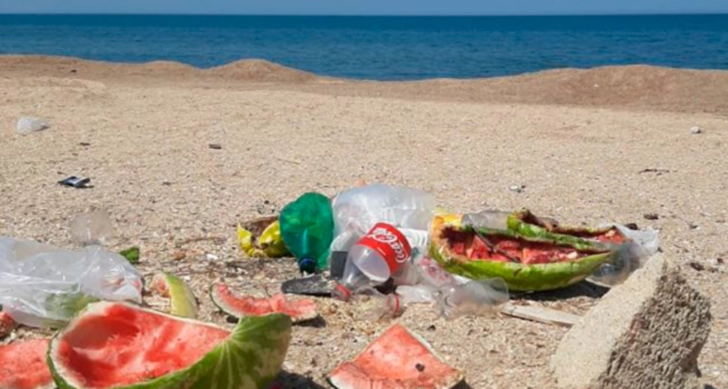
Every summer, the same images return from the Absheron coast: plastic bottles buried in the sand, food packaging floating near the water, discarded diapers, broken glass and overflowing garbage bags scattered across the shoreline.
The immediate explanation is obvious. Too many people treat the beach as someone else’s property and assume that somebody else will clean up after them.
A person who can carry food, drinks, toys and towels to the beach can also carry an empty bag back to the car. Leaving trash behind is not poverty, inconvenience or lack of infrastructure. It is a lack of respect for other people, for the city and for the sea itself.
But blaming everything on individual behavior is also too easy.
The beach crisis around Baku is not only a cultural problem. It is also the result of a rapidly growing city, shrinking public access to the coastline and a widening divide between those who can afford clean private beaches and those who cannot.
Fewer Free Beaches, More People
Baku has grown dramatically over the past several decades. More people live in the capital and surrounding settlements, more families own cars, and summer pressure on the Absheron coastline has increased.
At the same time, much of the coast has become harder to access.
Areas once used freely by the public are now blocked by fences, villas, restaurants, resorts and private beach clubs. Even where access is technically available, visitors may encounter paid parking, entrance fees or facilities designed primarily for paying customers.
This means that a growing population is being concentrated on a shrinking number of genuinely free beaches.
Those public beaches are often overcrowded and poorly equipped. Some have too few waste containers. Others lack toilets, showers, changing rooms, lifeguards or regular cleaning crews. Garbage containers fill up quickly, then wind, stray animals and birds spread the waste across the sand.
None of this excuses visitors who throw bottles or diapers onto the beach. But it helps explain why the problem is getting worse.
When thousands of people are compressed into a limited coastal area without adequate infrastructure, trash becomes not only a matter of personal behavior but also a failure of urban management.
A Clean Beach Is Becoming a Luxury
For wealthier residents, the solution is simple: pay for access to a private beach, pool or resort.
At some Sea Breeze venues, admission this season reaches 50 manats, or about $29, per person. For a family of four, that means 200 manats, or roughly $118, before food, transportation, drinks or other expenses.
Most families cannot afford to spend that amount every weekend simply to swim in the sea.
A visit to the Caspian should not be a luxury experience. It should remain one of the most affordable forms of summer recreation available to residents of Baku.
The result is an increasingly visible social division. Those with money can enter controlled, landscaped and regularly cleaned beach clubs. Everyone else is sent toward the remaining public areas, where overcrowding, limited infrastructure and weak enforcement create conditions for further deterioration.
Baku cannot accept a model in which clean beaches are reserved for those who can pay, while free beaches are allowed to become dumping grounds.
The Caspian Sea is not private property.
Personal Responsibility Still Matters
It is important not to turn the lack of infrastructure into an excuse for unacceptable behavior.
A missing garbage container does not force anyone to leave broken glass on the sand. An overcrowded beach does not require visitors to abandon food waste, cigarette packs or plastic bags.
People who throw garbage from car windows or leave it beside an empty container are not victims of poor municipal planning. They are making a conscious choice.
The idea that “someone is paid to clean it” is particularly damaging. Paying an entrance fee, parking fee or restaurant bill does not grant anyone the right to behave as if the coastline were a hotel room after checkout.
The beach is a shared public space. The broken bottle left behind today may injure someone else’s child tomorrow.
What Needs to Change
Baku needs a clear and publicly available network of genuinely free municipal beaches.
These should not be remote stretches of coast that exist only on an official list. They should be accessible by road and public transportation and equipped with parking, toilets, showers, changing facilities, lifeguards and enough covered waste containers for peak summer weekends.
Every public beach should have a clearly identified operator responsible for cleaning and maintenance. Visitors should know which agency or company is responsible and where complaints can be submitted.
During the summer season, cleaning must be continuous. Emptying containers once every few days is not enough when thousands of people are visiting the same area.
Waste containers should be placed close to the beach, not hundreds of meters away near the main road. They should also be closed or secured so that wind and animals cannot spread garbage across the coast.
Enforcement must become real rather than symbolic.
Fines for littering already mean little when people believe there is almost no chance of being caught. The amount of the penalty matters, but certainty matters more. Beach inspectors, cameras near entrances and parking areas, and regular patrols could make littering visibly punishable.
For those unable to pay a fine, community service could be introduced. Spending several hours cleaning the same coastline may be more educational than another public-awareness advertisement.
Restrictions on glass containers should also be considered at busy public beaches. Broken glass creates a direct risk to adults and children and remains buried in the sand long after the person responsible has left.
Commercial resorts and businesses operating along the coast should also contribute to maintaining nearby public areas. Companies earning money from proximity to the Caspian should help finance waste collection, public access and environmental protection.
This Is Not About Where People Come From
Discussions about dirty beaches often turn into attacks on people from particular regions or social backgrounds.
That is both unfair and useless.
Trash has no regional identity.
Poor people litter, and wealthy people litter. Some leave food packaging on public beaches. Others throw bottles from expensive cars.
The problem is not where someone was born. It is a combination of poor upbringing, weak public institutions and confidence that there will be no consequences.
Clean cities are not created by perfect citizens. They are created when personal responsibility is supported by good infrastructure and consistent enforcement.
The Sea Must Remain Public
There is a contradiction in demanding public access to the coast while treating that coast as a garbage dump.
But there is also a contradiction in blaming ordinary families while allowing free beaches to disappear or remain neglected.
Both sides of the problem must be addressed.
Residents must stop treating the shoreline as someone else’s responsibility. Authorities must guarantee clean, safe and genuinely accessible public beaches. Commercial operators must contribute to protecting the coast from which they profit.
A free beach does not have to be dirty.
And a clean beach should not be available only to those who can afford 50 manats per person.
AZE.US